
The PhD is not homework: Learning to take ownership of your research
When I started my PhD, one of the things I had to learn was that doing a PhD is not the same as doing homework. In school and university, you are often given an assignment, you complete it, and somebody tells you whether you did it correctly. A PhD is different. There may be supervisors, milestones, deadlines, and expectations, but ultimately the research project is yours.
That realization can be both liberating and uncomfortable.
In one of my earliest blog posts, I wrote that I initially wanted to show my supervisors every calculation I had made and every piece of work I had done. Over time, I realized that the success of the project depended largely on my own judgment. I also started to think of the PhD as my “playground”: a rare opportunity to spend several years exploring a topic in depth.
Taking ownership of your research does not mean that you should work in isolation or ignore your supervisor’s advice. It means gradually becoming the person who can make informed decisions about the direction, scope, and execution of the research.
Here are some reasons why taking ownership matters, together with practical ways to develop that sense of responsibility:
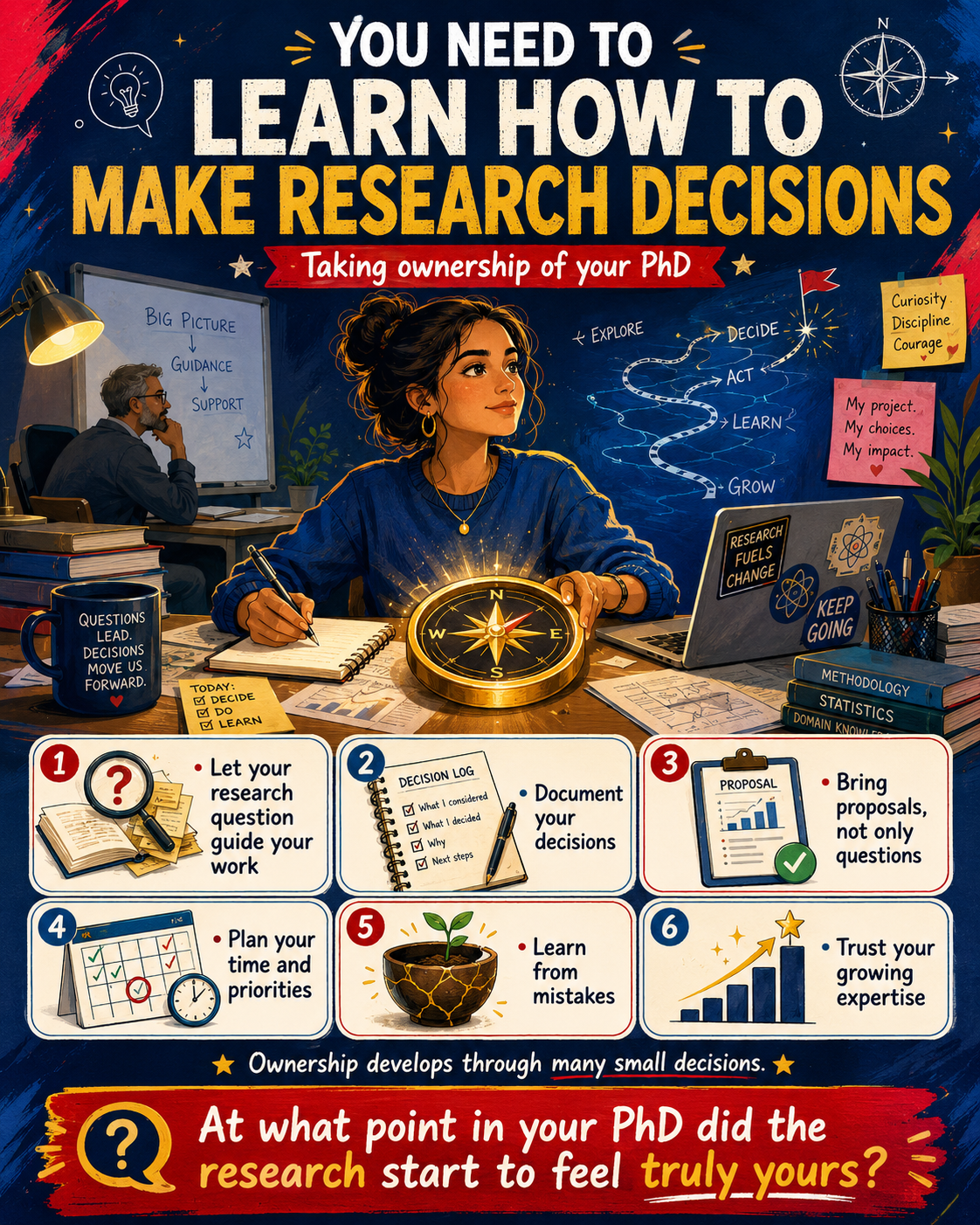
- You need to learn how to make research decisions.
At the start of a PhD, it is natural to look to your supervisor for reassurance. But your supervisor cannot make every decision for you. Over time, you need to become comfortable deciding which papers are worth reading, which analyses are necessary, which results deserve further investigation, and which ideas are outside the scope of your project. - Your research question should guide your work.
One of the easiest ways to lose ownership is to drift into interesting but ultimately irrelevant work. There is always another paper to read, another method to try, or another side question to explore. I have written before about how easy it is to lose focus by wanting to investigate too many things at once. Keep returning to your main research question and ask yourself whether the task in front of you is actually helping you answer it. - Document your decisions.
Keeping a research journal, lab book, or another system for documenting your work can help you see how your thinking develops. Document your journey early on, including keeping track of your activities and research decisions. Writing down why you made a particular choice can also make discussions with your supervisor much more productive. - Come to meetings with proposals, not only questions.
Instead of asking, “What should I do next?”, try saying, “I see three possible next steps, and I think option two is the strongest because…” You are still asking for feedback, but you are also practicing your own judgment. This small shift can change the dynamic of supervision and help you grow into a more independent researcher. - Take responsibility for planning your time.
Ownership is not only intellectual. It is also practical. A PhD requires you to manage milestones, writing, experiments, reading, presentations, and everything else that comes with academic work. Planning your weeks, setting priorities, and learning to estimate how much you can realistically accomplish are all part of managing your own project. These planning and prioritization skills are central parts of the PhD trajectory. - Accept that ownership includes making mistakes.
Independent research means that not every decision will turn out to be the right one. An analysis may lead to nowhere. An experiment may fail. You may spend too much time reading material that turns out not to be useful. These experiences are not separate from becoming an independent researcher; they are part of the process. The important question is what you learn from them and how you adjust your next steps. - Develop confidence in your expertise.
As your PhD progresses, you will know more and more about your specific research problem. Your supervisor may have broader experience, but you are the person spending your days immersed in the details of your project. Learning to trust that growing expertise is an important part of finding your academic voice and developing authority as a researcher.
Taking ownership of your PhD does not happen overnight. It develops gradually, through hundreds of small decisions: choosing what to read, deciding what to leave out, planning the next experiment, defending an interpretation, or suggesting the next step in a meeting. At some point, you may notice that you are no longer waiting for somebody to tell you what to do. You have become the person steering the project. And that, perhaps more than any completed chapter or checked-off milestone, is one of the most important transformations of the PhD journey.
At what point in your PhD did you start to feel that the research was truly yours?