Submission tips from a journal editor
As a journal editor, I see manuscripts at a very early stage of the publication process. As Editor-in-Chief of Structural Engineering International, I check every paper that has passed the initial administrative check before deciding whether it should move forward and which editor should handle it.
That means I also see many manuscripts that could have avoided an early rejection with a little more preparation.
Submitting a journal paper is not just about finishing the research and uploading the manuscript. You also need to make sure that the paper fits the journal, fits the readership, and is presented in a way that makes it easy for an editor to understand why the work matters.
Here are some of my main submission tips:
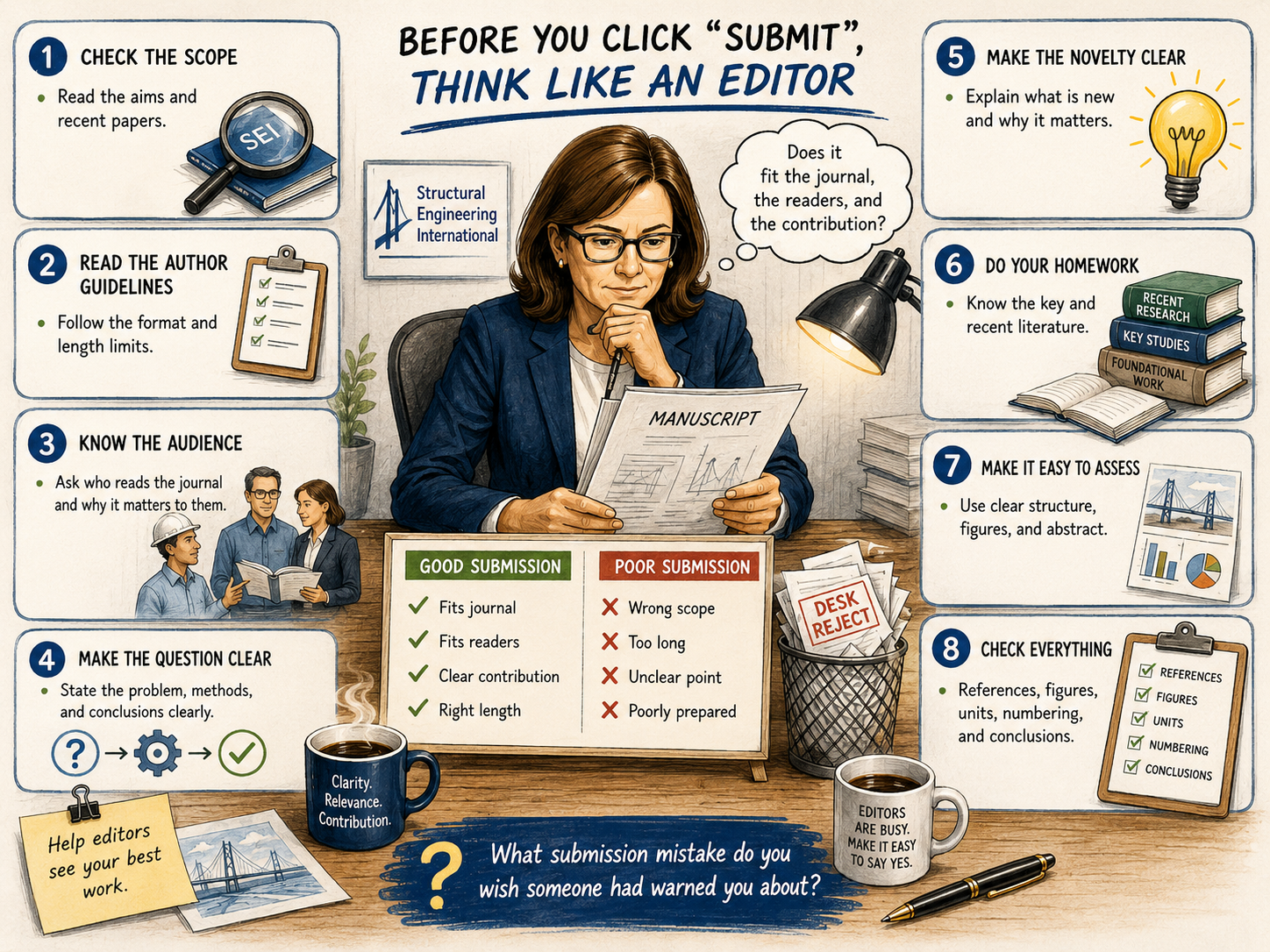
- Check the scope of the journal. Please, please do this before you submit. Read the aims and scope carefully and look at recently published papers. If your topic clearly does not belong in the journal, the manuscript will not make it very far. And yes, as an editor of a structural and bridge engineering journal, I have received papers from completely unrelated fields. Do not simply submit wherever a search engine or AI tool tells you to submit.
- Read the instructions for authors. In particular, check the maximum length. If the journal publishes papers of around 10 pages, do not send me a 60-page manuscript and expect me to figure out how it could somehow fit. Editors are not there to cut your thesis chapter down for you. You need to understand the format and prepare the manuscript accordingly.
- Know the audience, not just the scope. A paper can technically fit the scope and still be wrong for the journal. Structural Engineering International, for example, is a practice-oriented journal. Our readers include practicing engineers. That means I am looking for papers that are useful, interesting, and relevant to people working in practice. Ask yourself: who reads this journal, and why would they care about my work?
- Make your research question clear. I should not have to read ten pages before I understand what problem you are trying to solve. State the research question or objective clearly. A strong manuscript has a clear line from the problem, through the methods, to the results and conclusions.
- Make the novelty clear. What is new here? What does your work contribute that we did not know before? Do not simply state that your topic is important. Explain how your study advances knowledge, improves a method, provides new data, or offers something useful to the journal’s readers.
- Do your homework. Know the literature. Make sure you have read the relevant work, including recent work. Do not build an introduction around a handful of generic references while ignoring the main research in the field. At the same time, do not turn the introduction into a catalogue of everything that has ever been published. The literature should help you establish the problem and position your contribution.
- Make the paper easy to assess. Editors are busy. Reviewers are busy. Help us understand your work. Use a logical structure, clear figures, informative captions, and a concise abstract. If the main contribution is hidden under pages of unnecessary background, your manuscript becomes much harder to evaluate.
- Check everything before submitting. Check the references. Check the figures. Check the units. Check the numbering. Check that tables are cited in the text. Check that your conclusions are supported by your results. If you used AI tools during writing, you are still responsible for every sentence, reference, figure, and claim in the manuscript.
A good submission does not guarantee acceptance. The research still needs to be sound, relevant, and sufficiently novel, and reviewers may identify important weaknesses.
But a poor submission can prevent good research from ever getting a fair chance.
Before you click “submit,” take one final look at the manuscript from the editor’s perspective. Does it fit the journal? Does it fit the readers? Is the contribution obvious? Is it the right length? Is it polished enough that someone else can focus on the research rather than the avoidable problems around it?
That final check can make a significant difference.
What is one submission mistake you wish someone had warned you about earlier in your academic career?