
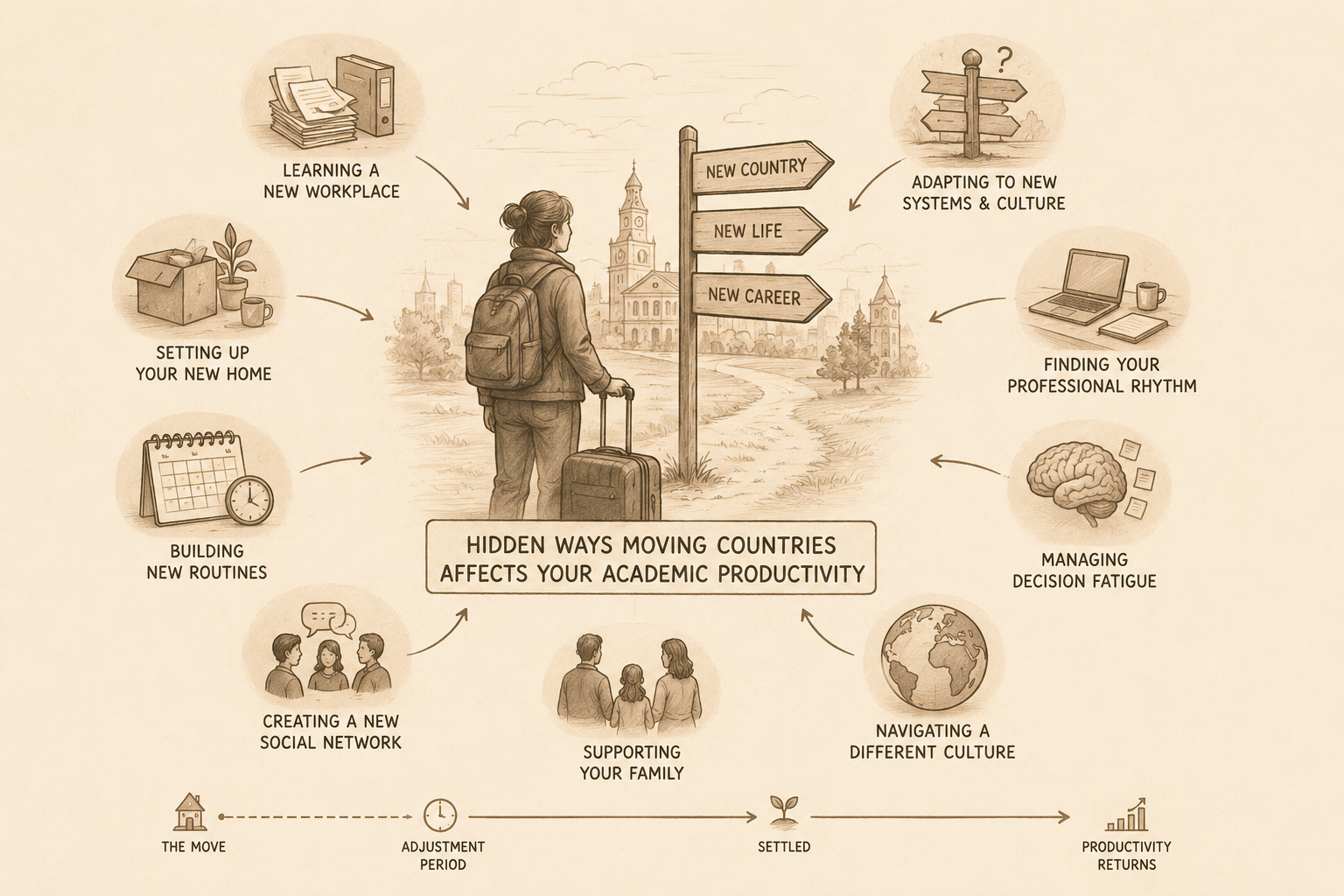
The Hidden Ways Moving Countries Affects Your Academic Productivity
One of the realities of an academic career is that international mobility is often part of the journey. You may move abroad to start your PhD, relocate for a postdoctoral position, accept a faculty appointment in another country, or move after your PhD to be closer to family or a partner. Or you can be hopping back and forth between two continents, like I do ;/
While these moves can be exciting opportunities for professional and personal growth, they also come with a temporary dip in productivity that is easy to underestimate. We tend to focus on the logistics of the move itself (packing boxes, arranging visas, and booking flights) but the adjustment continues long after the last suitcase has been unpacked.
If you have recently moved, or are about to relocate, it is worth recognizing that your productivity may not immediately return to its previous level. This is not a sign that you are falling behind. Rather, it is a natural consequence of building a new life while continuing your academic work.
Some of the hidden ways an international move can temporarily affect your productivity include:
- Learning a new workplace. Every institution has its own systems, administrative procedures, software, and unwritten rules. Even simple tasks often take longer until you know where to find information and who to ask.
- Setting up your new home. Finding accommodation, buying furniture, arranging internet, opening bank accounts, registering with local authorities, and dealing with utilities all require time and mental energy.
- Building new routines. Your old routines no longer fit your new environment. You need time to discover the best commuting options, grocery stores, childcare arrangements, gyms, or simply where to go for a walk after work.
- Creating a new social network. Leaving behind colleagues, friends, and family means starting over socially. Building meaningful connections with new colleagues takes time but is essential for feeling at home.
- Supporting your family. If you move with a partner or children, everyone is adjusting simultaneously. Your partner may be looking for work, children may be settling into new schools, and family routines need to be rebuilt together.
- Navigating a different culture. Even when moving to a country where you speak the language, there are differences in communication styles, workplace expectations, and daily life that require constant adaptation.
- Managing decision fatigue. During the first weeks or months, every day involves dozens of small decisions that previously required no thought. This additional cognitive load leaves less mental capacity for deep research.
- Finding your professional rhythm again. Research often depends on sustained concentration. It takes time before your writing, reading, or experimental work regains its previous flow.
The important thing to remember is that this adjustment period is temporary. Academia often celebrates mobility as a sign of ambition and opportunity, but we do not always acknowledge the hidden work involved in starting over. Give yourself permission to view settling into a new country as part of your work rather than as a distraction from it.
If possible, adjust your expectations during the first few months after a move. Celebrate small wins, focus on establishing routines before chasing peak productivity, and remember that investing time in building a stable life outside work will ultimately support your research. Once the practical and emotional foundations are in place, your productivity is likely to return—and often with fresh perspectives gained from your new environment.
How did moving internationally affect you?