
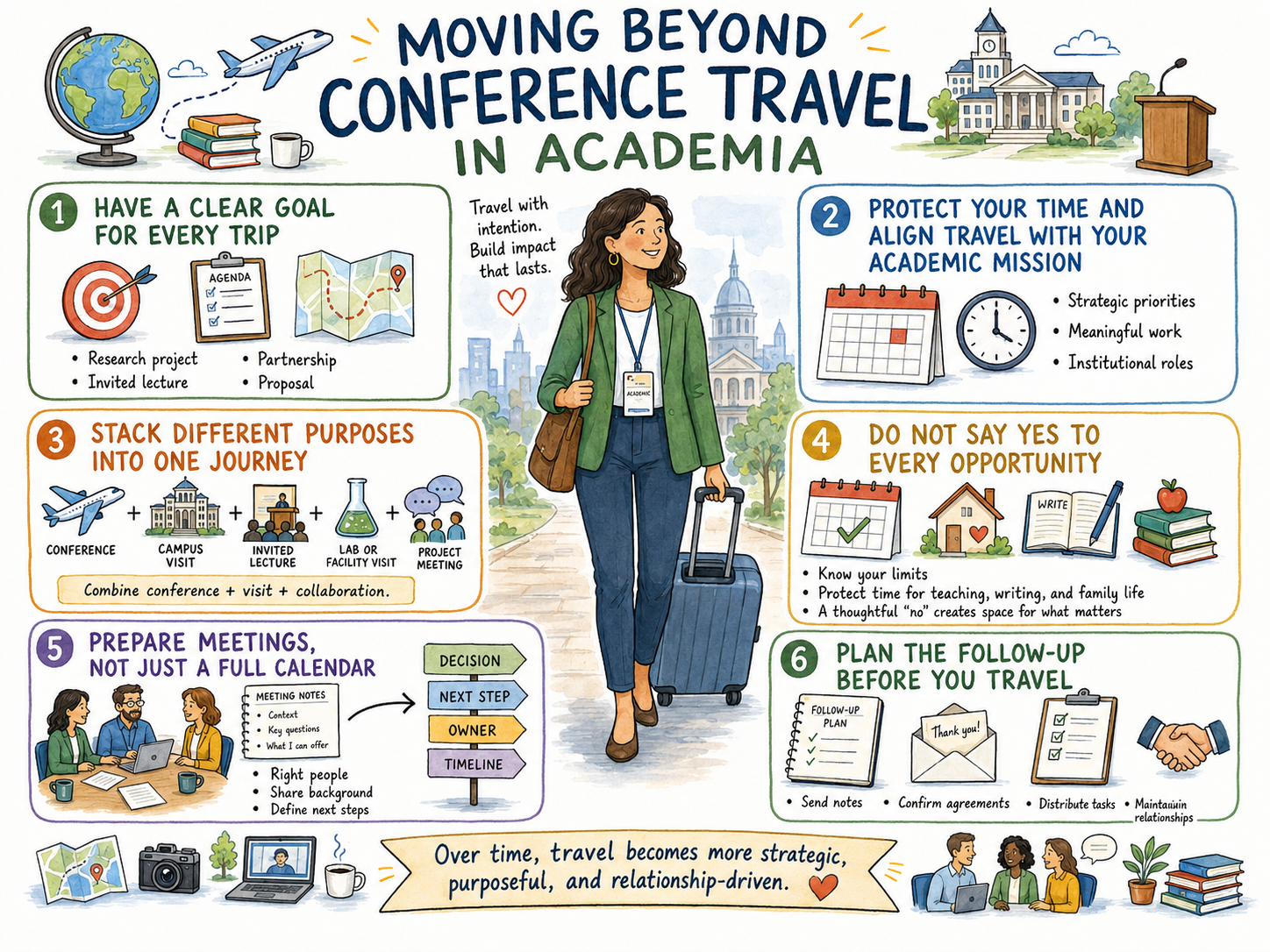
Moving Beyond Conference Travel in Academia
For many years, most of my international academic travel revolved around conferences, and then my annual research stay in Delft. I would travel to present a paper, chair a session, attend committee meetings, meet colleagues, and learn about the latest developments in my field. Conferences provided a clear reason for traveling and, usually, a ready-made program to follow.
Over time, however, the nature of my international travel has changed. Conferences remain part of my schedule, but they are no longer the only reason I travel. Increasingly, my trips involve university visits, invited lectures, research projects, strategic meetings, and ‘”academic diplomacy”: building relationships between institutions, exploring opportunities for collaboration, and representing my universities internationally. These trips require a different type of preparation and a more deliberate approach to planning academic travel.
Here are six things I keep in mind as my travel shifts beyond conferences.
- Have a clear goal for every trip.
Before accepting an invitation or booking a flight, determine what the trip should achieve. Are you moving a research project forward, strengthening an institutional partnership, developing a proposal, delivering specialized training, or exploring a future collaboration? A clear goal helps you decide whom to meet, what to prepare, and what a successful outcome would look like. - Protect your time and align travel with your academic mission.
International invitations can be exciting, but not every trip deserves a place in your calendar. Consider whether the visit supports your current responsibilities and longer-term academic direction. At this stage of my career, I prioritize travel that contributes to academic diplomacy, advances major projects, strengthens strategic partnerships, or serves my institutional roles. This selection process is closely related to the broader challenge of protecting time for meaningful academic work. - Stack different purposes into one journey.
A conference trip does not need to consist only of attending the conference. Especially when a long flight is involved, explore whether you can add a university visit, meet a project partner, give an invited lecture, visit a laboratory, or discuss a possible collaboration. Combining activities reduces the number of separate journeys you need to make and can also reduce the environmental impact of conference travel. - Do not say yes to every opportunity.
Travel creates opportunities, but it also takes time away from writing, teaching, supervision, administration, and family life. A calendar filled with international trips may look impressive while leaving very little time to complete the work that those trips generate. Just as we need realistic expectations when developing our academic schedules, we need limits around travel. - Prepare meetings rather than simply filling the calendar.
Project and institutional visits often depend on a relatively small number of important conversations. Identify the right people, share background information beforehand, and formulate the decisions or next steps you would like to reach. Many of the principles for organizing efficient academic meetings apply equally well during international visits. - Plan the follow-up before you travel.
The real value of a visit often becomes visible only after you return. Reserve time to send notes, confirm agreements, distribute tasks, prepare documents, and maintain the relationships you developed. Without follow-up, even an excellent visit can remain a pleasant conversation rather than becoming a concrete collaboration.
As international travel becomes more varied, it also becomes more strategic. A trip is no longer simply an event on the calendar. It can be part of a broader process of building trust, representing an institution, advancing research, and creating opportunities for students and colleagues.
At the same time, more travel is not automatically better. The goal is to choose trips carefully, combine purposes intelligently, and make sure that every journey supports the work and academic mission that matter most.
How has the purpose of your academic travel changed as your career has developed?