
How I use AI to address reviewer comments
Getting reviewer comments can be frustrating. Even when the comments are useful, there is usually a moment of disappointment, irritation, or simply not knowing where to start. I have written before about how I normally respond to reviewer comments, and my usual approach is to first identify the major issues before working through the details.
Recently, I received a rejection for a paper that I actually thought was quite good. I decided not to use the journal transfer option, because I did not want to simply send the exact same paper somewhere else. Reading the reviews, I could also see one important weakness myself: I had not explained clearly enough how the two parts of the research belonged together.
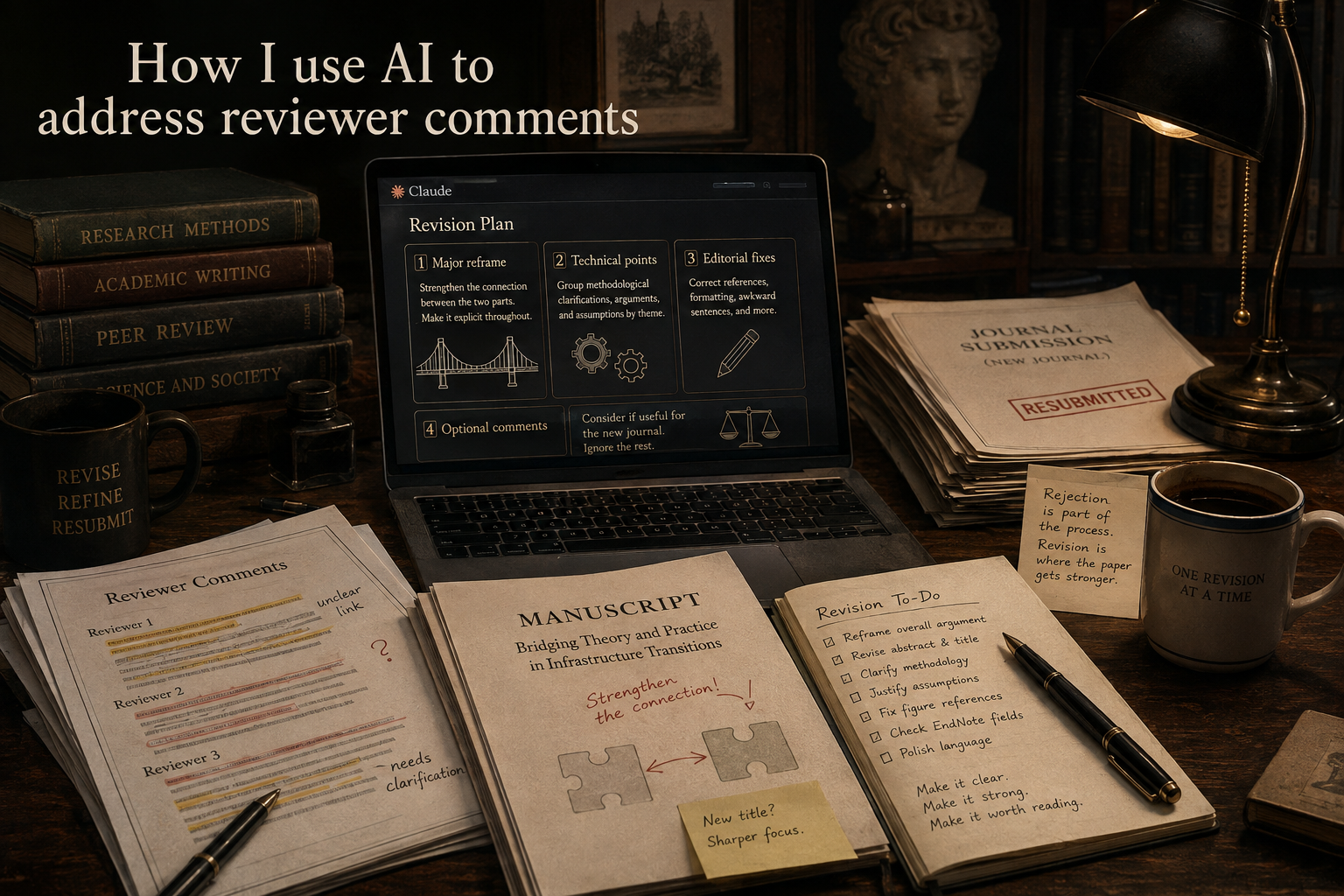
Before I started revising the paper, I uploaded the manuscript and the comments from all three reviewers to Claude Cowork and asked it to make me a plan for improving the paper. Claude created an artifact with a structured revision plan. That turned out to be very helpful.
The plan broadly separated the revision into the following categories:
- The major reframe
The most important point was to strengthen the link between the two parts of the paper. Claude suggested making that connection explicit throughout the manuscript rather than expecting the reader to infer it. It also suggested retitling the paper (which I graciously ignored, I much preferred my original title), sharpening the abstract, formulating two research questions, and revising the transition into the second part so that it clearly built on the first.
This was particularly useful because reviewers tend to look at both the overall argument and the technical details of a manuscript, as I discussed in my post on what reviewers look for in a submission.
- Technical points that needed clarification
Claude then grouped the more technical comments from the three reviewers. These included places where the methodology needed further explanation, parts of the argument that were not sufficiently clear, and assumptions that needed to be justified better.
Having these comments grouped by theme made them much easier to tackle than working through three separate reviewer reports sequentially.
- Editorial fixes
Next came the easy wins: incorrect figure references, EndNote fields that had not converted properly, awkward sentences, and other small editorial issues. These were straightforward to fix, but still important. Small errors can distract from the argument, and I have written before about common mistakes in journal papers. Cowork put all this information together in a table that I could work through.
- Comments I could choose whether to address
Finally, Claude identified a number of comments that were more optional. Since I was submitting to a different journal, I did not feel that I needed to address every individual preference or pet peeve of the original reviewers. Instead, the artifact separated out points that I could consider bringing into the discussion if they strengthened the manuscript, while leaving me free to ignore those that did not.
What I liked most about this approach is that AI did not revise the paper for me. It helped me diagnose the reviews and turn a pile of comments into a workable revision plan. That distinction matters to me. I still made all the decisions myself, but I started with a much clearer overview of what needed to change. Instead of toggling through three lists of comments, I got the overview from larger problems to editorial that I could work through. Given that rejection is simply part of academic work, I think this is one way in which AI can make the process a little less overwhelming.
The revised manuscript has now been submitted to another journal, so I hope the stronger framing will lead to a better outcome this time.
Have you used AI to help you make sense of reviewer comments, and did it change the way you revised your paper?