The First-Year PhD Checklist: What to Set Up Early
I have written before about how I, as a PhD supervisor, onboard my PhD students. In that post, I shared the checklist I use to make sure a new PhD candidate has the information, access, and structure they need to get started. But, of course, onboarding practices vary widely between universities, faculties, departments, research groups, and supervisors.
Some PhD candidates arrive in a group where everything has been carefully prepared: office space, computer access, a research plan, meetings, training, and introductions to key people. Others start in a much more informal way and are expected to figure things out as they go. Neither situation is necessarily better or worse, but the second one can lead to confusion if expectations are not made explicit early on.
So, if you are starting your PhD, you can also take matters into your own hands. You do not need to wait passively until somebody tells you what to do. A PhD is not homework; it is your project, and part of the transition into doctoral research is learning to take ownership of the process. At the same time, taking ownership does not mean guessing what your supervisor, funding body, or institution expects from you. It means asking the right questions early and documenting the answers.
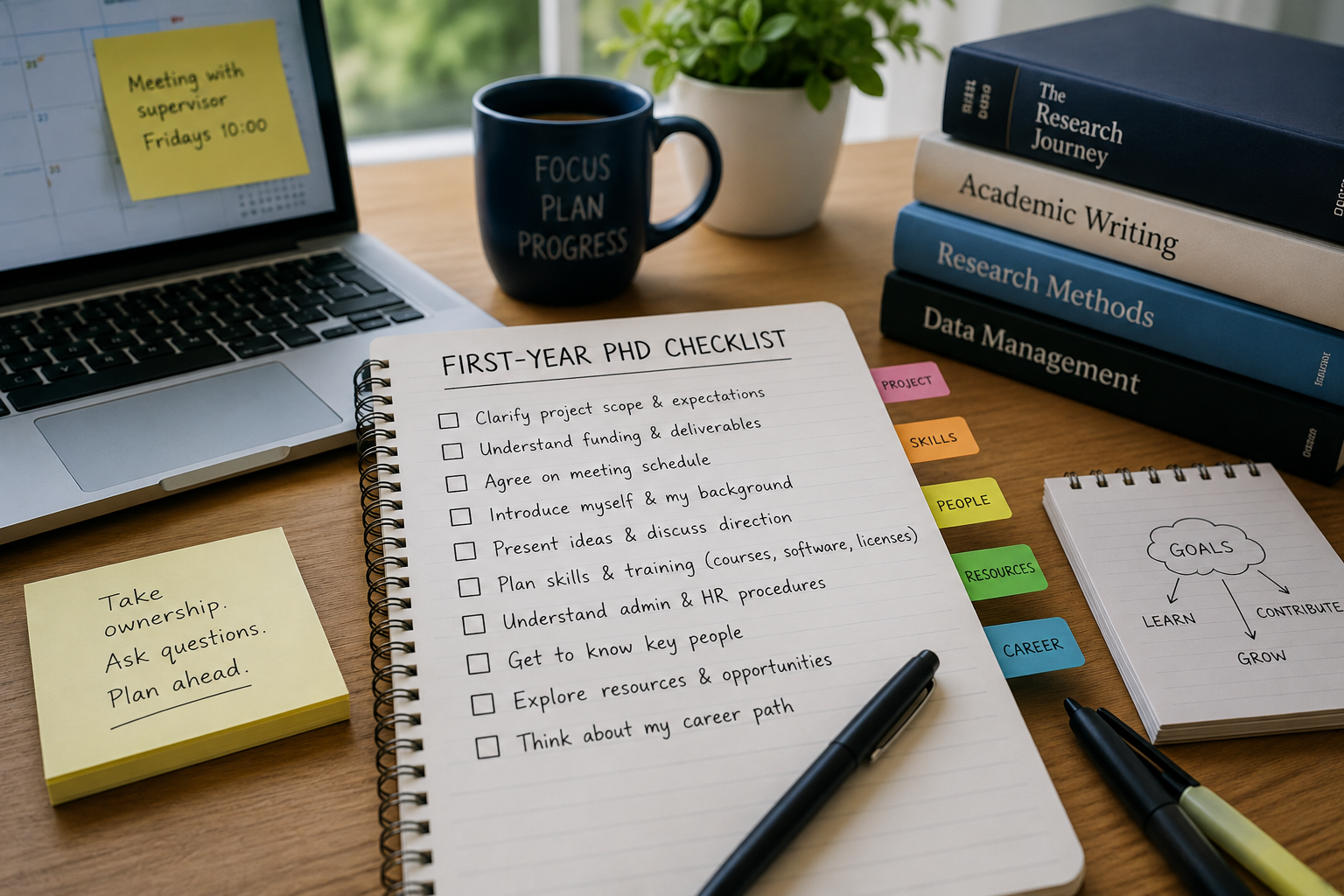
Here is a first-year PhD checklist of things to set up early:
- Clarify expectations about the project itself. Ask your supervisor how they understand the scope of the project. What is fixed, and what is still open for discussion? Are there specific research questions, methods, case studies, datasets, experiments, or collaborations that are already part of the project? What would a successful first year look like? Try to come out of this conversation with a shared understanding of the direction of the work.
- Understand the requirements that come with the funding. Your position may be funded by a university, a research council, an industry partner, a scholarship, or another source. Each type of funding comes with different expectations. There may be reporting requirements, project meetings, deliverables, travel budgets, teaching obligations, or limits on what the money can be used for. Knowing this early helps you understand the larger context of your PhD.
- Discuss expected deliverables. Ask what concrete outputs are expected in the first year and throughout the PhD. These may include a research proposal, literature review, progress report, conference abstract, journal paper, dataset, code, laboratory results, coursework, or a presentation for a project meeting. Deliverables help turn the large, vague goal of “doing a PhD” into manageable milestones.
- Agree on your meeting schedule. Discuss how often you will meet with your supervisor. Will you have a weekly meeting at a fixed time, or will meetings be scheduled more flexibly? Who is responsible for setting the agenda? How far in advance should you send documents? Will you also meet with co-supervisors, postdocs, or project partners? Regular meetings can provide structure, especially in the first year when everything still feels new.
- Set up a meeting template. A fixed template can make supervision meetings more useful. You could include: progress since the previous meeting, current questions, planning for the next period, skills you are learning, reflections on what is going well or not so well, next steps, and decisions that need to be made. This simple structure can help you avoid meetings that drift without clear outcomes.
- Introduce yourself properly. Do not assume your supervisor knows your background in detail. Prepare a short introduction about where you are from, what you studied, what methods or topics you already know, what you feel confident about, and what is new to you. This conversation helps your supervisor understand how to guide you and where you may need additional training.
- Present your ideas early. Even if your ideas are still rough, bring them to the table. Share what you find interesting, what questions you have after initial reading, and where you see possible directions. Your ideas will change, but presenting them early helps you become an active participant in shaping the project.
- Make a skills plan. List the skills you think you will need for your PhD and your broader career plan. These may include academic writing, programming, statistics, qualitative methods, laboratory techniques, data management, teaching, project management, or presenting. Discuss which skills you already have, which you need to develop, and how you will learn them.
- Identify courses, software, licenses, and access needs. Beyond formal courses, think about the practical tools you need. Do you require software licenses, access to specialized programs, laboratory training, safety certification, data repositories, equipment, archives, or fieldwork permissions? It is much easier to arrange these things before you urgently need them.
- Ask about administrative and HR procedures. Make sure you understand the practical side of your appointment. Ask about contracts, salary or stipend payments, holidays, sick leave, travel reimbursement, purchasing procedures, visa or residence matters if relevant, and who to contact when questions arise. Administrative confusion can take a lot of mental space, so clear it up early.
- Map the people around you. Get to know the key people in your research environment: lab staff, technicians, secretaries, administrative assistants, IT support, postdocs, fellow PhD candidates, and faculty members. These are the people who often know how things actually work.
- Ask who else you should meet. Depending on your project, you may need to meet other faculty members, collaborators, industry partners, laboratory managers, data stewards, or external stakeholders. Ask your supervisor how introductions are usually made and what your role should be in these relationships.
- Learn what you can use in the group, faculty, and university. Find out what resources are available: writing groups, grant support, statistical consulting, teaching training, career services, mental health support, library workshops, PhD councils, research seminars, and professional development programs. Many useful resources exist, but you may only discover them if you ask.
- Explore professional associations. Ask which academic societies, conferences, working groups, or professional associations are relevant in your field. Getting involved early can help you understand the wider research community and see where your work fits.
- Start the career conversation early. At the beginning of the PhD, you may not know whether you want to continue in academia, move to industry, work in government, start a company, or do something else entirely. That is normal. Still, it is useful to discuss possible career paths from the start. Ask your supervisor to revisit this conversation with you every six months, so your training, networking, publications, teaching, and professional development can support the direction you are exploring.
The first year of a PhD is full of uncertainty, and not all of that uncertainty can or should be removed. Research is, by definition, partly unknown. But practical uncertainty about expectations, meetings, funding, training, access, and communication can often be reduced by asking good questions early.
A strong start does not mean having the entire PhD mapped out in detail. It means setting up the structures that allow you to learn, adapt, and make decisions as you go. When expectations are clear from the beginning, you give yourself more space to focus on the actual work of becoming an independent researcher.
What are your best tips for starting PhD candidates?