How research proposals get reviewed
In my previous post, I shared some of the lessons I learned from serving on a review panel for a competitive research funding opportunity. Several readers reached out afterward with a similar question: what actually happens on the other side of the process?
As researchers, we spend a great deal of time writing proposals, but relatively few of us get to see how applications are evaluated once they are submitted. While every funding scheme has its own procedures, many review processes follow a similar structure. The exact forms, timelines, and administrative details may differ, but the underlying principles are often the same: applications are evaluated against predefined criteria, reviewers discuss their assessments, and recommendations are made based on the available funding and the goals of the program.
Without discussing any specific funding opportunity, I’d like to share a general overview of how a proposal review process can work. Understanding this process may help researchers better appreciate what happens after they submit their applications and why certain elements of proposal writing matter so much.
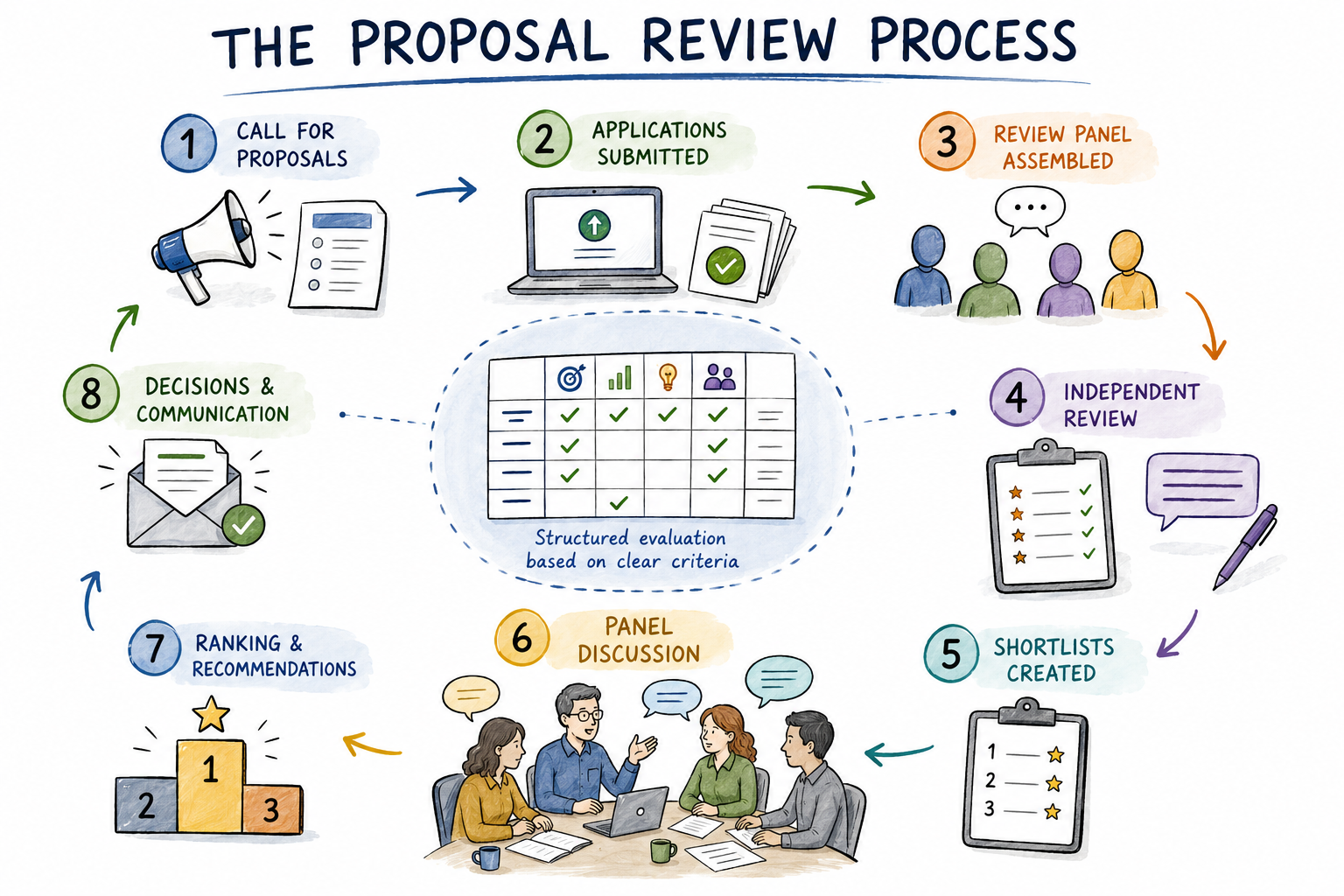
- The funding call is launched and proposals are collected. Every review process begins with a call for proposals. Researchers prepare their applications based on the published objectives, requirements, and evaluation criteria. Once the submission deadline passes, proposals are collected and checked to ensure they meet the formal requirements of the call. Depending on the funding scheme, applications may then be distributed among review panels, institutions, or subject-matter experts for evaluation.
- A review panel is assembled. One of the first steps in the review process is bringing together a group of reviewers. Ideally, this group represents different areas of expertise and perspectives. Many funding calls attract applications from a variety of disciplines, so having reviewers with complementary backgrounds helps ensure that proposals are evaluated fairly and thoroughly. An interdisciplinary review team can also help prevent evaluations from becoming too narrowly focused on one particular research tradition or methodology.
- A structured evaluation framework is developed. Funding calls generally include evaluation criteria, but reviewers often benefit from having a common framework for assessing proposals consistently. This framework typically mirrors the criteria described in the call itself. Rather than simply assigning scores, reviewers are encouraged to document strengths, weaknesses, concerns, and observations. Having written comments available later becomes particularly important during discussions, as it helps reviewers explain the reasoning behind their assessments.
- Reviewers assess proposals independently. Before any group discussion takes place, reviewers generally evaluate proposals on their own. This independent assessment stage is important because it allows each reviewer to develop an unbiased opinion before hearing the perspectives of others. During this phase, reviewers consider questions such as:
- Does the proposal align with the objectives of the call?
- Is the project feasible?
- Does the team have the expertise needed to carry out the work?
- Is the expected impact convincing?
- Does the budget support the proposed activities?
- Reviewers identify their strongest proposals. Once the individual reviews have been completed, reviewers typically identify the proposals they consider most competitive. This step helps distinguish between applications that are solid and those that stand out. In many funding schemes, the challenge is not finding good proposals. The challenge is selecting a limited number of proposals from a pool that contains many strong submissions. Establishing an initial ranking or shortlist helps focus the subsequent discussions.
- The review panel meets to discuss the applications. After the independent review stage, the panel comes together to discuss the proposals. The first part of the discussion often focuses on eligibility questions or proposals that clearly do not meet certain requirements. The panel then reviews the broader pool of applications, comparing observations and discussing areas where reviewers may have had different interpretations. The written comments collected during the review stage are particularly useful here because they provide concrete examples and evidence for the discussion.
- Consensus is built through discussion. One aspect of review panels that may surprise applicants is how often reviewers independently arrive at similar conclusions. While differences in scoring certainly occur, there is often substantial agreement regarding the strongest and weakest aspects of a proposal, or the proposals with most potential.The purpose of the discussion is not necessarily to achieve unanimous agreement on every detail. Rather, it is to ensure that different perspectives are heard and that the final recommendations are supported by clear reasoning and evidence.
- Recommendations are prepared. Based on the discussions, the panel develops its recommendations. This may involve creating a ranked list, identifying a group of highly recommended proposals, or otherwise advising the coordinating body responsible for the funding decisions. This stage can be challenging because funding is usually limited. Even excellent proposals may not ultimately receive support if available resources are insufficient.
- Results are consolidated and decisions are finalized. In larger funding programs, recommendations from multiple reviewers or review panels are often brought together and compared. Coordinators examine the evaluations, identify areas of agreement, and ensure that decisions remain aligned with the goals and criteria of the funding program. Once the final decisions have been made, applicants are informed of the outcome.
- The administrative work begins. For successful applicants, receiving funding is not the end of the process but the beginning of a new phase. Budgets need to be activated, agreements finalized, and reporting requirements clarified. Before any research activities can begin, there is often a considerable amount of administrative work that takes place behind the scenes.
Looking back on my experience serving as a reviewer, what stands out most is the importance of having a structured and transparent process. When a funding call attracts many strong applications, reviewers need a systematic approach that allows them to evaluate proposals fairly and consistently.
Understanding the review process can also help researchers think differently about proposal writing. Reviewers are not simply reading applications in isolation. They are comparing many proposals, discussing their strengths and weaknesses, and trying to make difficult decisions with limited resources. A proposal that is clear, well-structured, and closely aligned with the objectives of the call makes that task significantly easier.
The next time you submit a proposal, it may be worth remembering that a review panel is likely working through a process similar to this one. While there are no guarantees in competitive funding, helping reviewers understand your project quickly and clearly remains one of the most effective ways to strengthen your application.
Have you served on a review panel? If so, was your experience similar?