
What reviewing research proposals taught me
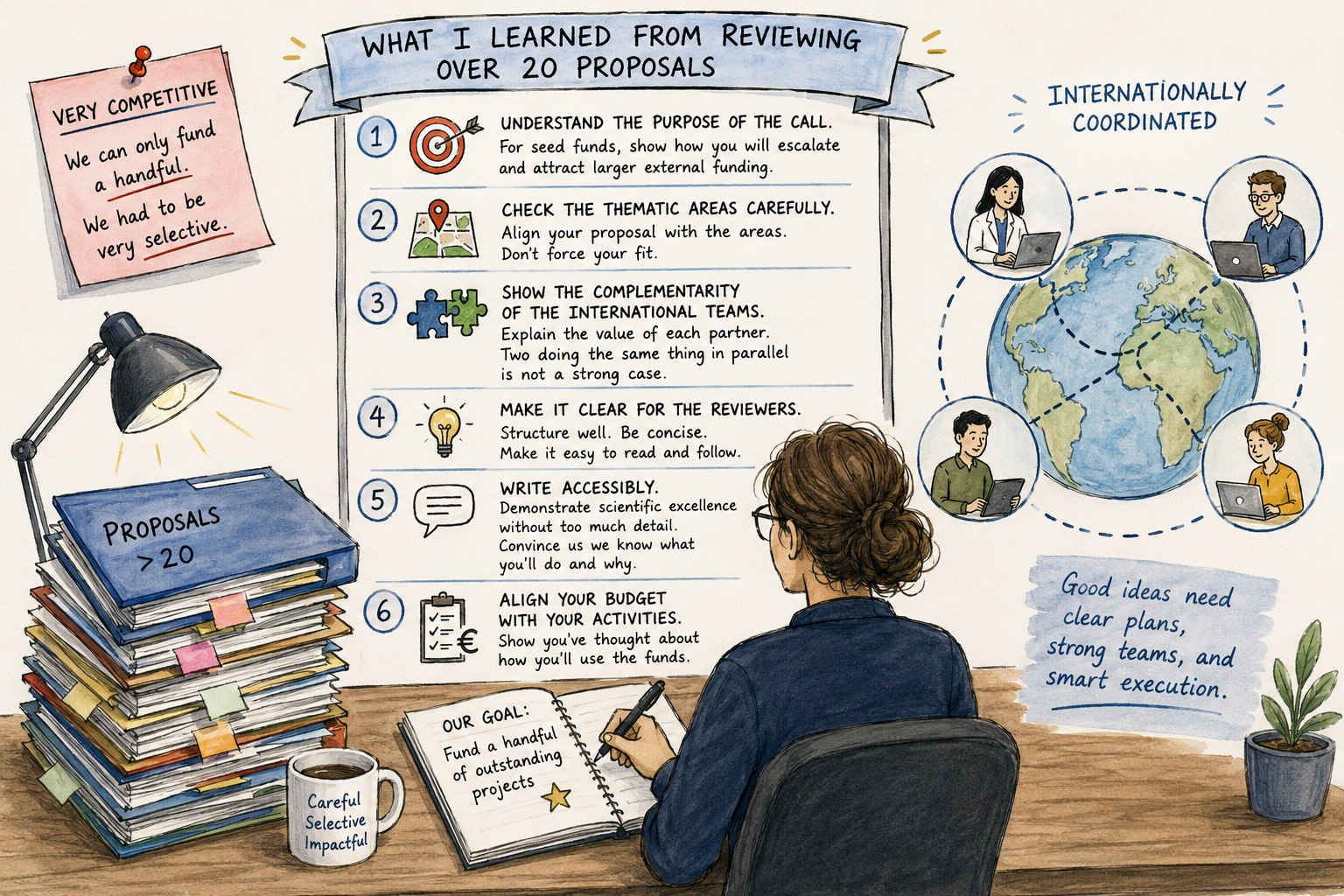
Recently, I had the opportunity to review more than 20 proposals submitted for a funding call. The funding available through this program is limited, which means the competition is fierce: only a handful of projects will ultimately receive support. As reviewers, we had to be highly selective and make difficult choices between many strong submissions.
This particular funding scheme is built around international collaboration, bringing together researchers from different institutions. As a result, we were not only evaluating the scientific ideas themselves, but also the strength of the proposed partnerships and the potential for creating meaningful international research networks.
Reading so many proposals in a relatively short period of time was an interesting experience. While every proposal was unique, I noticed several recurring patterns that distinguished stronger applications from weaker ones. For researchers preparing future proposals, here are the main lessons:
- Understand the purpose of the call.
This may sound obvious, but many proposals miss the mark because they do not fully align with the objective of the funding scheme. If a call offers seed funding, for example, reviewers are not necessarily looking for a complete, self-contained research program. Instead, they want to see how the proposed activities will lead to larger opportunities in the future. How will this project position the team to apply for major external grants? Which ones will you shoot for? How will the seed fund generate preliminary results and establish collaborations? The strongest proposals clearly demonstrated how the seed funding would serve as a stepping stone toward larger ambitions. - Study the thematic areas carefully and align your proposal accordingly.
Most calls define priority areas or strategic themes. Reviewers can quickly tell when applicants have selected a focus area simply because they needed to check a box on the application form. Instead of trying to force your project into a category, carefully examine the different themes and identify where your work genuinely fits. Then make that alignment explicit throughout the proposal. A convincing proposal shows a natural connection between the project objectives and the priorities of the funding program. - Demonstrate the value of the international collaboration.
In international funding schemes, collaboration itself is often one of the key evaluation criteria. Therefore, it is important to explain why the partners are working together and what each partner brings to the table. The strongest proposals clearly articulated the complementary expertise of the participating teams. Perhaps one institution contributes experimental facilities while another offers modeling expertise. Perhaps the teams work on similar challenges in different contexts and can learn from each other’s experiences. Simply having two groups conduct similar work in parallel is rarely a compelling justification. Reviewers want to understand why the partnership creates value that would not exist otherwise. - Make life easy for the reviewers.
Reviewers may read dozens of applications in a short period of time. A proposal that is well structured, easy to navigate, and clearly written immediately has an advantage. This does not mean oversimplifying your ideas; rather, it means helping reviewers quickly understand the problem, the approach, and the expected outcomes. Clear headings, logical organization, and concise writing all contribute to a stronger proposal. - Balance scientific excellence with accessibility.
Many applicants feel the need to showcase every technical detail of their methodology. While scientific rigor is important, excessive detail can sometimes obscure the main message. A strong proposal convinces reviewers that the team knows exactly what it is doing without overwhelming them with technical minutiae. Remember that review panels often include experts from different fields rather than specialists in your exact niche. Explain your work at a level that demonstrates excellence while remaining accessible to a broader audience. Reviewers should finish reading with a clear understanding of what you will do, why it matters, and why your team is capable of delivering it. - Ensure that the budget supports the proposed activities.
One of the easiest ways to weaken an otherwise promising proposal is to present a budget that feels disconnected from the project plan. Reviewers want evidence that the team has carefully considered how the funds will be used and how the execution of the budget maps to the timeline of the project. The budget should clearly support the proposed activities and expected outcomes. If travel is included, explain how it contributes to collaboration and project objectives. If workshops, meetings, or research visits are proposed, show how they fit into the overall strategy. A strong budget tells reviewers that the team has thought carefully about execution rather than simply listing a series of desirable activities.
Reviewing these proposals reminded me that successful grant applications are not only about having a good idea. Many submissions contained interesting research questions, but the strongest proposals were those that clearly aligned with the objectives of the call, articulated a compelling collaboration strategy, and communicated their plans in a way that was easy for reviewers to follow.
As researchers, we often spend most of our time thinking about the science itself. Yet funding decisions are frequently influenced by how effectively we communicate our ideas, demonstrate alignment with program goals, and show a realistic path toward impact. Keeping these principles in mind can significantly improve the chances that reviewers will understand and appreciate the value of your proposed work: for you as a scientist, for your institution, and for society at large.
As a grant reviewer, what are your best tips?