The Difference Between Conference Travel and Project Travel
From the outside, conference travel and project travel can look almost identical. In both cases, you may be away from your office and teaching duties for one or two weeks. You need to book transportation and accommodation, rearrange meetings, prepare for your absence, and catch up when you return. To your colleagues at home, the practical impact may seem much the same: you are traveling for work.
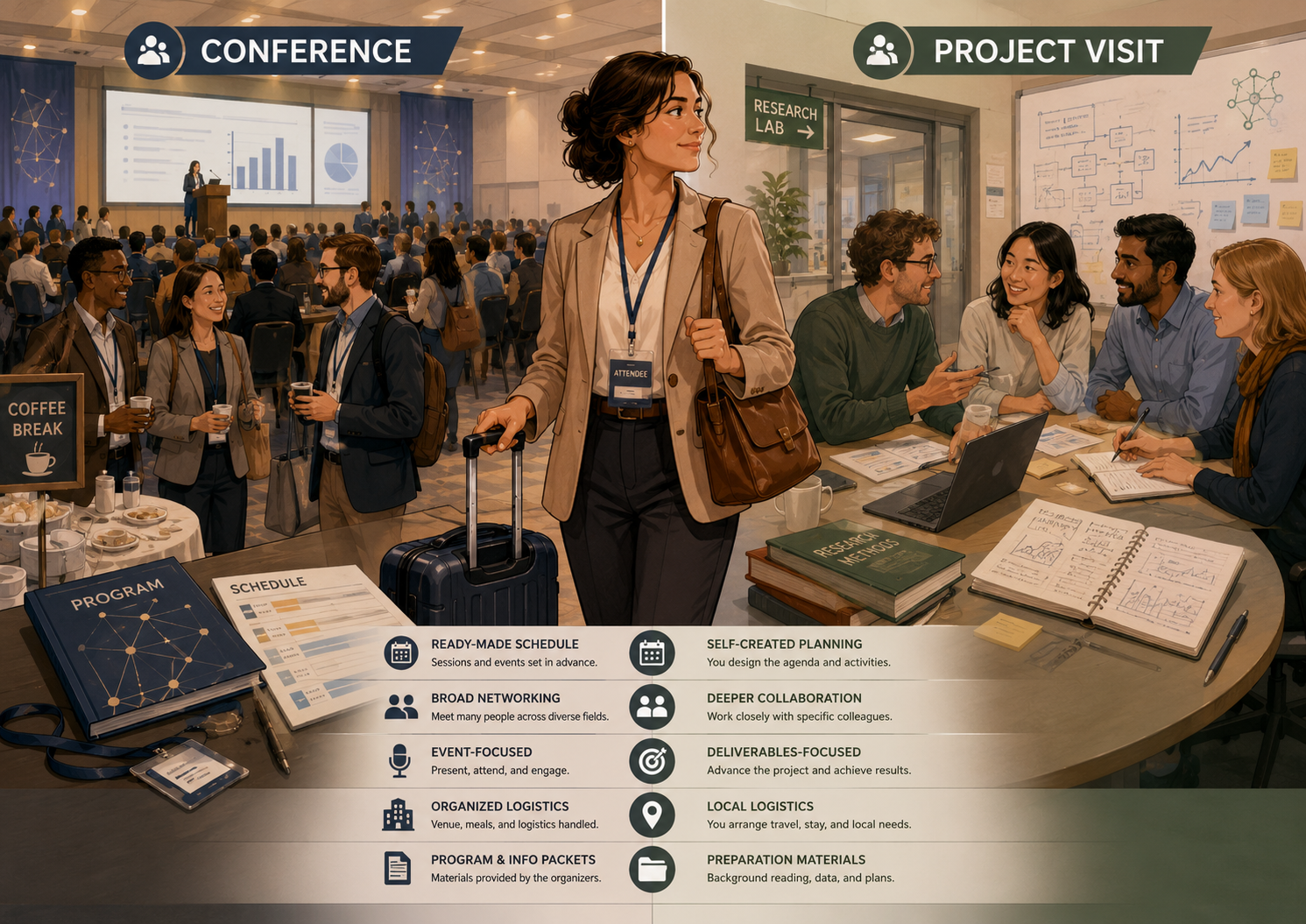
However, the purpose and rhythm of these two types of academic travel are quite different. When you attend a conference, you enter an event that has already been organized for you. When you visit another university as part of a research project, you are not simply attending an event. You are helping to create the working visit itself. Here are five differences to keep in mind.
- You need to create your own schedule.
A conference comes with a program. The sessions, keynote lectures, coffee breaks, poster sessions, and social events have already been scheduled. During a project visit, there is usually no ready-made program. You and your colleagues need to decide what you want to achieve and build the schedule around those goals. You may need to arrange meetings, writing sessions, laboratory visits, discussions with doctoral candidates, and blocks of time for focused work. Do not arrive expecting the week to organize itself. - The logistics require more local input.
Conference organizers often recommend hotels, explain how to reach the venue, and provide information about transportation and meals. For a university visit, you will need to ask your local colleagues for advice. Which neighborhood is convenient? How should you travel to campus? Do you need building access, a temporary office, or permission to enter a laboratory? Asking these questions early can prevent unnecessary stress once you arrive. - The intended outcome is different.
At a conference, your main academic task is often to present work that has already reached a certain level of completion. You share your ideas, receive feedback, learn from others, and become more visible within your research community. During project travel, the focus is usually on moving the work forward. The visit should contribute to project deliverables, resolve open questions, produce decisions, or create a concrete next step. It helps to define these expected outcomes before the trip. - Networking is broader at a conference and deeper during a project visit.
Conferences give you the opportunity to meet many people. Some conversations may be brief, but they can introduce you to new researchers, methods, and possible collaborations. During a project visit, your network is smaller and more focused. You spend more time with the same colleagues, understand how they work, and build stronger professional relationships. Shared meals and informal conversations may be just as important as scheduled meetings. - Your preparation should reflect the type of interaction.
For a conference, you prepare a presentation, poster, or paper and think about how to communicate your completed results clearly. For a project visit, you need to prepare materials that support collaboration. These may include draft documents, datasets, calculations, lists of questions, preliminary results, or decisions that require discussion. Your colleagues should receive relevant materials in advance so that the visit can begin with substantive work rather than lengthy explanations.
Because the travel arrangements may look similar, it is easy to approach a project visit as though it were a small conference. However, doing so can lead to an unfocused week. A successful project visit requires more initiative before departure and more clarity about what you and your colleagues want to accomplish together.
At the same time, project travel can be especially valuable. Working side by side can move a collaboration forward in ways that online meetings cannot always achieve. The key is to treat the visit as a focused period of joint work rather than simply as time spent at another university.
What differences have you noticed between conference travel and traveling to work with colleagues on a research project?