I’d rather read Tolstoy
Every few months, another business leadership book finds its way to me. Usually, it comes recommended by a colleague, or mentioned in a meeting as the one book every leader must read this year. And yes, I do read some of them. I read nonfiction, I read management books, and I do believe they can contain useful ideas. But increasingly, I find myself thinking the same thing halfway through: I’d rather be reading Tolstoy.
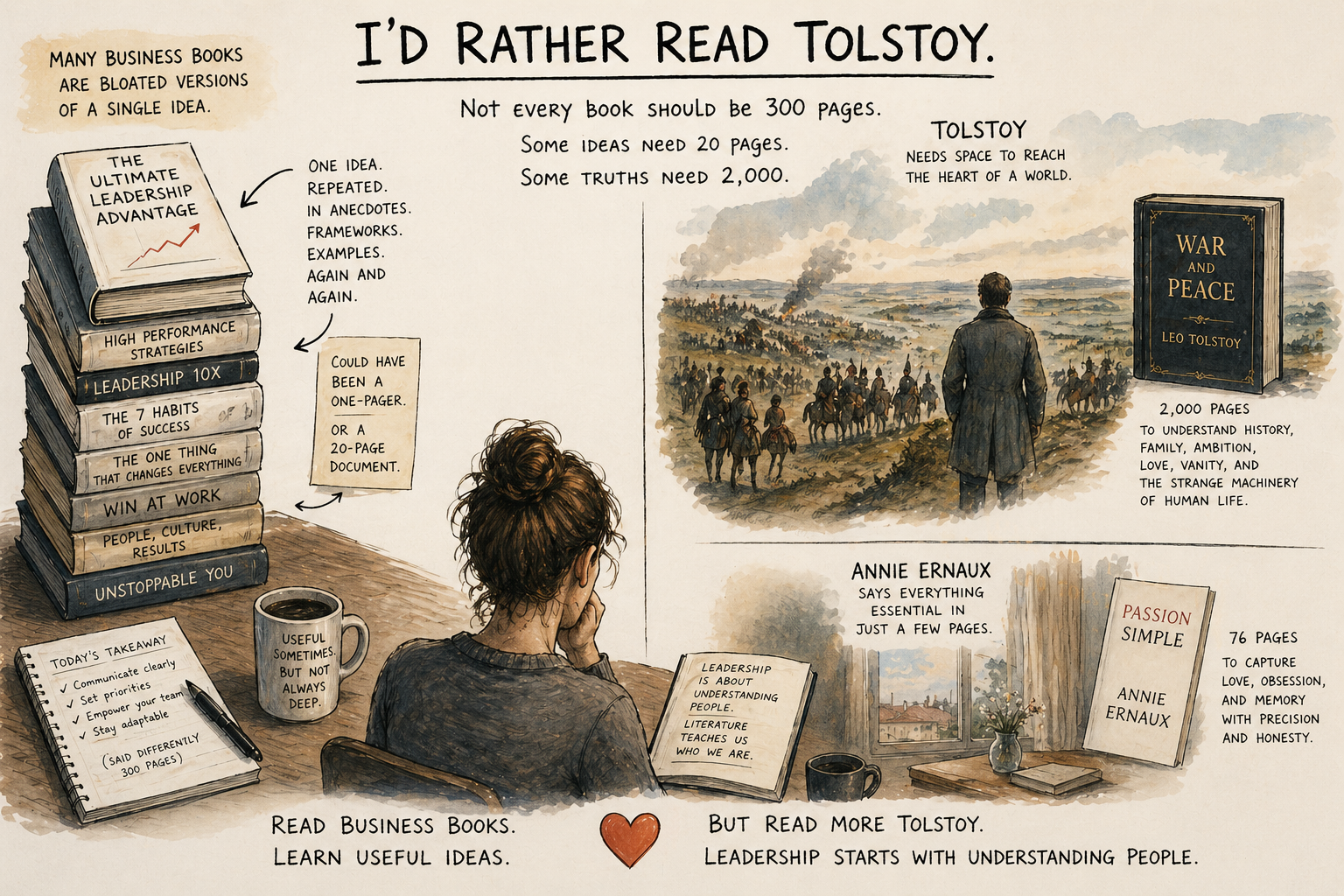
The problem is not that business books are useless. Many of them are built around genuinely valuable insights: how to lead teams better, how to communicate clearly, how to make better decisions. The problem is that too often, these books are bloated versions of a single idea. What could have been a sharp one-page memo, or perhaps a thoughtful twenty-page essay, becomes a 300-page monument to repetition, padded with case studies that prove the same point over and over. The same concept is dressed up in anecdotes, airport stories, and endless frameworks until the original idea disappears under its own weight.
And why, exactly, has 300 pages become the default length for every book? Why do we seem to assume that seriousness must come in the form of 100,000 words?
Literature reminds us that length should serve the subject, not the market. Annie Ernaux can describe heartbreak, obsession, memory, and desire in barely sixty pages. In works like Passion simple, she reaches emotional truths that many authors fail to approach in entire trilogies. Brevity, when done well, is not reduction; it is precision.
At the other end of the spectrum stands Leo Tolstoy. If Ernaux proves that some truths need only a whisper (or, more aptly for Ernaux: a hot breath in your neck), Tolstoy proves that others require an entire universe. War and Peace is enormous not because it is indulgent, but because it must be. To understand history, family, ambition, love, vanity, and the strange machinery of human life, Tolstoy needs space. He earns every page.
That is the real lesson: not every book should be 300 pages. Some ideas deserve twenty. Some deserve two thousand. The current publishing habit of forcing everything into the same standard length flattens both thought and reading.
And this brings me back to leadership. If we want to understand people—really understand them—we may learn more from Tolstoy than from the latest executive bestseller. Leadership is, after all, about human nature: ambition, insecurity, loyalty, conflict, pride, fear, and hope. Fiction takes us inside these experiences in ways management books rarely can. Tolstoy lets us sit in the minds of people we would never otherwise understand. Ernaux shows us the emotional precision of a single life. They teach empathy, observation, and judgment—the very qualities good leaders need most.
So yes, read the business books. Some are useful, and some are excellent. But perhaps not all of them need to be books. Perhaps some should have remained essays.
And then, with the time you save, read a little more Tolstoy. Leaders would be better for it.