Grant writing these days
Even now, as Vice Dean for Research, I still apply for funding. A lot of projects.
Some people assume that once you move into academic leadership, grant writing becomes something you leave behind. In reality, it is quite the opposite. If I want my research to keep moving forward, I still need projects, collaborations, and the resources to make them happen. Administrative leadership may shape the broader research environment, but it does not replace the need to keep building your own research program. Moreover, it is only a temporary position, so I can’t afford to let the engine of my research to slow down.
So yes, I still apply for nearly every relevant funding opportunity that crosses my desk.
What has changed, however, is how I approach these applications. I no longer have the same amount of uninterrupted time to write proposals from scratch, and I need to make sure that my responsibilities as Vice Dean and as a researcher can coexist sustainably. I have adjusted my approach so that I can continue pursuing research funding without letting proposal writing take over everything else.
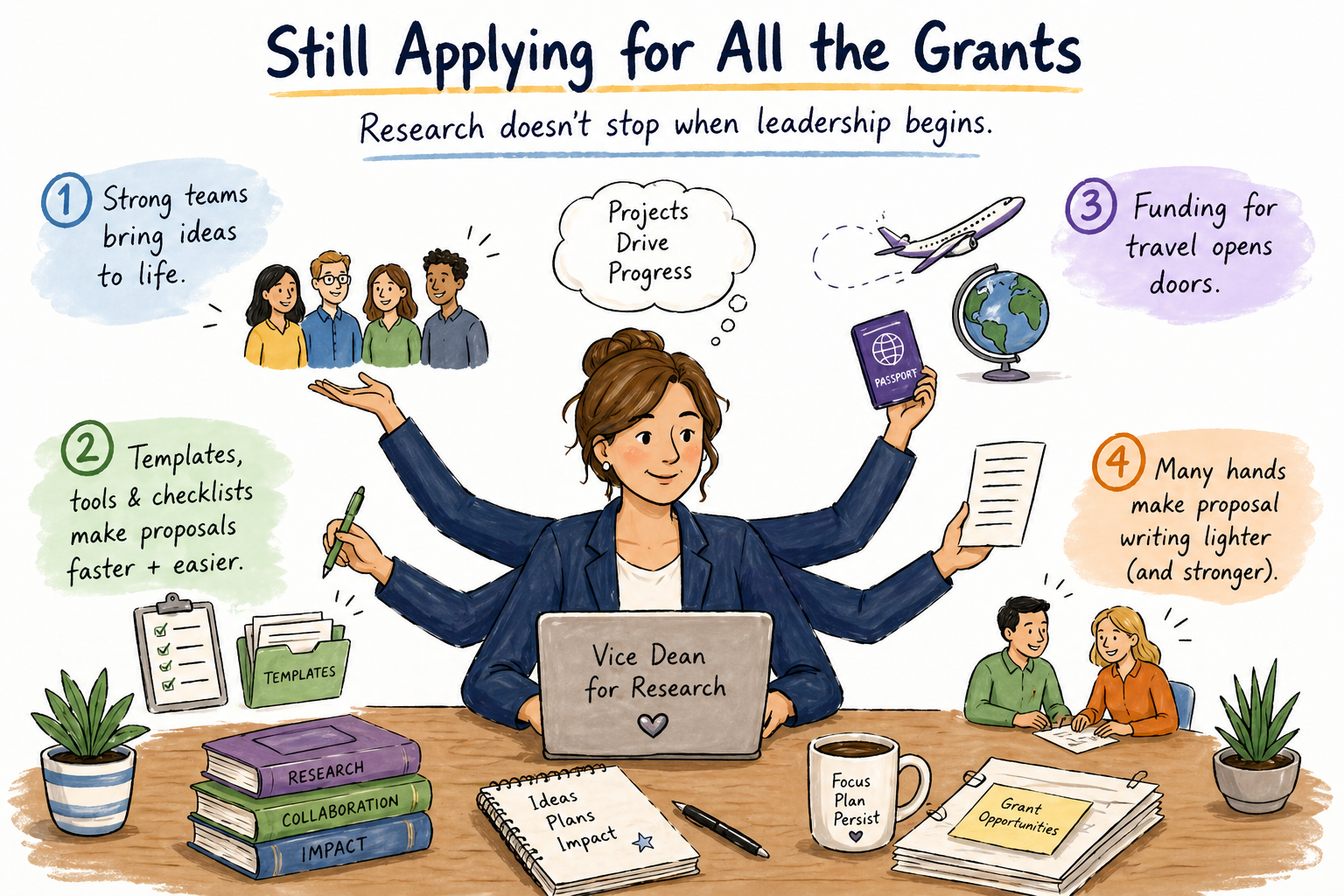
Here are a few of the things I do differently now:
- I build proposals around strong teams.
I make sure to include enough colleagues and collaborators so that the actual research has enough hands on deck. This means the project is not dependent on me being involved in every operational detail. I can contribute at a higher strategic level—shaping the research questions, mentoring junior colleagues, and ensuring quality—while the day-to-day work is shared across the team. Good projects are team efforts anyway, and stronger teams also make stronger proposals. - I rely on templates, tools, and checklists.
After writing many proposals over the years, I have learned that not everything needs to start from a blank page. I have developed templates for recurring sections, standard descriptions of facilities and expertise, standard checklists to make sure nothing gets forgotten, planning files, gantt chart files, and ways to make my figures. I also have tools that help me track deadlines, required documents, and submission requirements. Experience matters, but systems matter just as much. They save time and reduce stress. - I still look for funding for travel and international activities.
My current position has a strong focus on internationalization, and while there is some institutional travel funding available, I still want my research-related travel to be supported through project funding whenever possible. Conferences, research visits, invited lectures, and international collaborations are all essential parts of academic life. Having dedicated funding for these activities makes a significant difference and protects other limited budgets. - I ask for more help with proposal writing.
I may still set up the overall proposal structure, define the vision, and make sure the story is coherent, but I no longer try to write every paragraph myself. I ask colleagues to contribute sections related to their expertise, provide supporting documents, and handle some of the practical elements of the submission. Proposal writing works much better as a shared effort. It also creates stronger ownership of the project across the team.
Applying for funding never really stops in academia; it simply evolves. The key is learning how to do it in a way that matches your current career stage and responsibilities. I still apply for all the grants, but I do it with better systems, stronger teams, and a clearer understanding that sustainable research requires shared effort. Grant writing is not just about securing money; it is about creating the conditions for good research to continue.
How has your proposal writing approach changed over time?