My top 10 time management tips for academics
Academic careers can be rewarding, but they also come with a unique challenge: there is always more work than time. Between research, teaching, administration, mentoring, proposal writing, meetings, and service, it can feel impossible to stay on top of everything.
Over the years, I have learned that time management is not really about managing time. We all have the same 24 hours in a day. Instead, it is about making deliberate choices. The key question is not “How can I do more?” but “How can I focus on what matters most?”
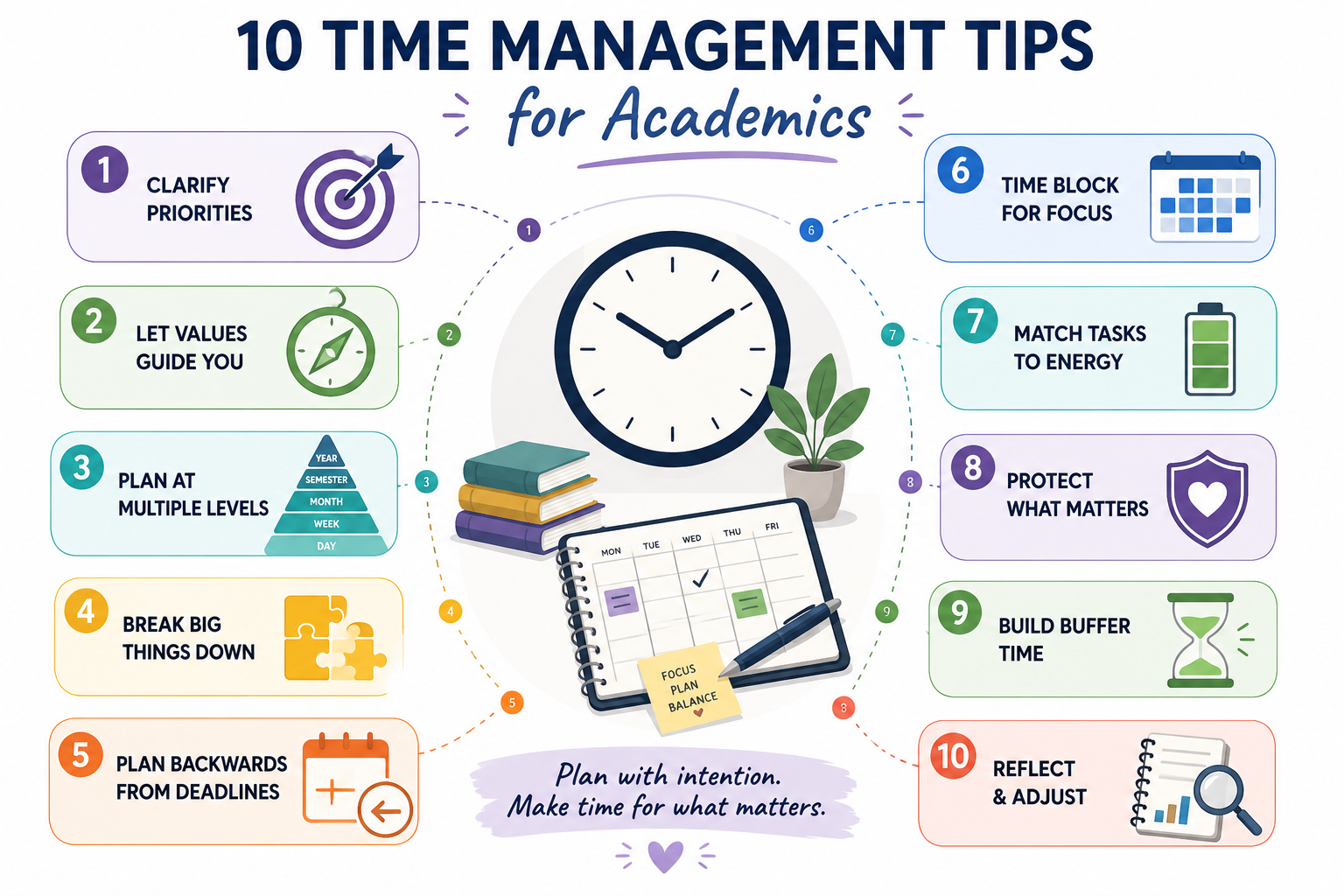
Here are my top 10 time management tips for academics.
- 1. Start with your priorities: Time management begins with clarity. Before planning your week, ask yourself what matters most in your current season of life and career. Your priorities today may be different from those of five years ago, and your schedule should reflect that reality.
- 2. Let your values guide your decisions: When competing demands arise, your values can serve as a compass. If you value creativity, relationships, excellence, or service, make sure your calendar reflects those values. Otherwise, urgent tasks will always crowd out what is truly important.
- 3. Plan at multiple levels: I like to think about planning on five levels: year, semester, month, week, and day. Annual goals guide semester priorities, semester priorities shape monthly plans, and monthly plans translate into weekly and daily actions. When these levels align, everyday tasks contribute to long-term goals.
- 4. Break big projects into manageable steps: Large projects often feel overwhelming because they are too vague. Instead of writing “finish proposal” on your to-do list, identify the specific next actions. Progress happens when we transform ambitious goals into concrete tasks.
- 5. Plan backwards from deadlines: One of the most effective techniques I use is backward planning. Start with the final deadline and work backwards through all the required steps. This approach reveals when you actually need to begin and helps avoid last-minute stress.
- 6. Use time blocks for focused work: Important work rarely happens by accident. Reserve dedicated blocks of time in your calendar for activities that require concentration, such as writing, analysis, or strategic thinking. During these blocks, eliminate distractions and focus on one clearly defined task.
- 7. Match tasks to your energy levels: Not all hours are equal. Most people have periods of the day when they are naturally more focused and creative. Schedule your most demanding cognitive work during those high-energy periods, and save administrative tasks and routine meetings for lower-energy moments.
- 8. Protect the important but not urgent: Many academic leaders spend their days responding to urgent requests. Yet the activities that have the greatest long-term impact—writing, strategic planning, mentoring, building collaborations, and professional development—often fall into the “important but not urgent” category. If these activities are not scheduled, they rarely happen.
- 9. Build buffer time into your schedule: Unexpected issues are inevitable. Projects take longer than expected, meetings run over time, and life happens. Leave room in your schedule for delays and emergencies. A resilient plan always includes margins.
- 10. Make reflection a monthly habit: The best time management system is the one that evolves with you. At the end of each month, ask yourself four simple questions: What did I accomplish? What did I not accomplish? What worked well? What did not work well? These reflections provide valuable insights for improving your planning and productivity.
Time management is not about creating the perfect schedule. It is about making intentional choices, protecting what matters most, and adjusting when reality inevitably disrupts our plans. As academics, we will never finish everything on our lists. The goal is not to do everything; it is to spend our time on the things that matter most. Plan thoughtfully, leave room for flexibility, and remember that sustainable productivity includes rest, reflection, and the occasional opportunity to enjoy the journey.