My current workout plan
As I’ve been regularly reporting on my workouts, I wanted to share my new training split. I recently finished a summer of fairly unstructured training, maintaining my strength and simply lifting what felt good on the day. Now it is time to get back to a proper program.
My current tested maxes are a 112.5 kg squat, 80 kg bench press, and 132.5 kg deadlift, although those numbers no longer tell the whole story. I’ve been squatting 100 kg for multiple reps quite regularly, and recently pulled 120 kg for eight reps. So, for the next 16 weeks, the goal is simple: build strength and then see what I can actually lift.
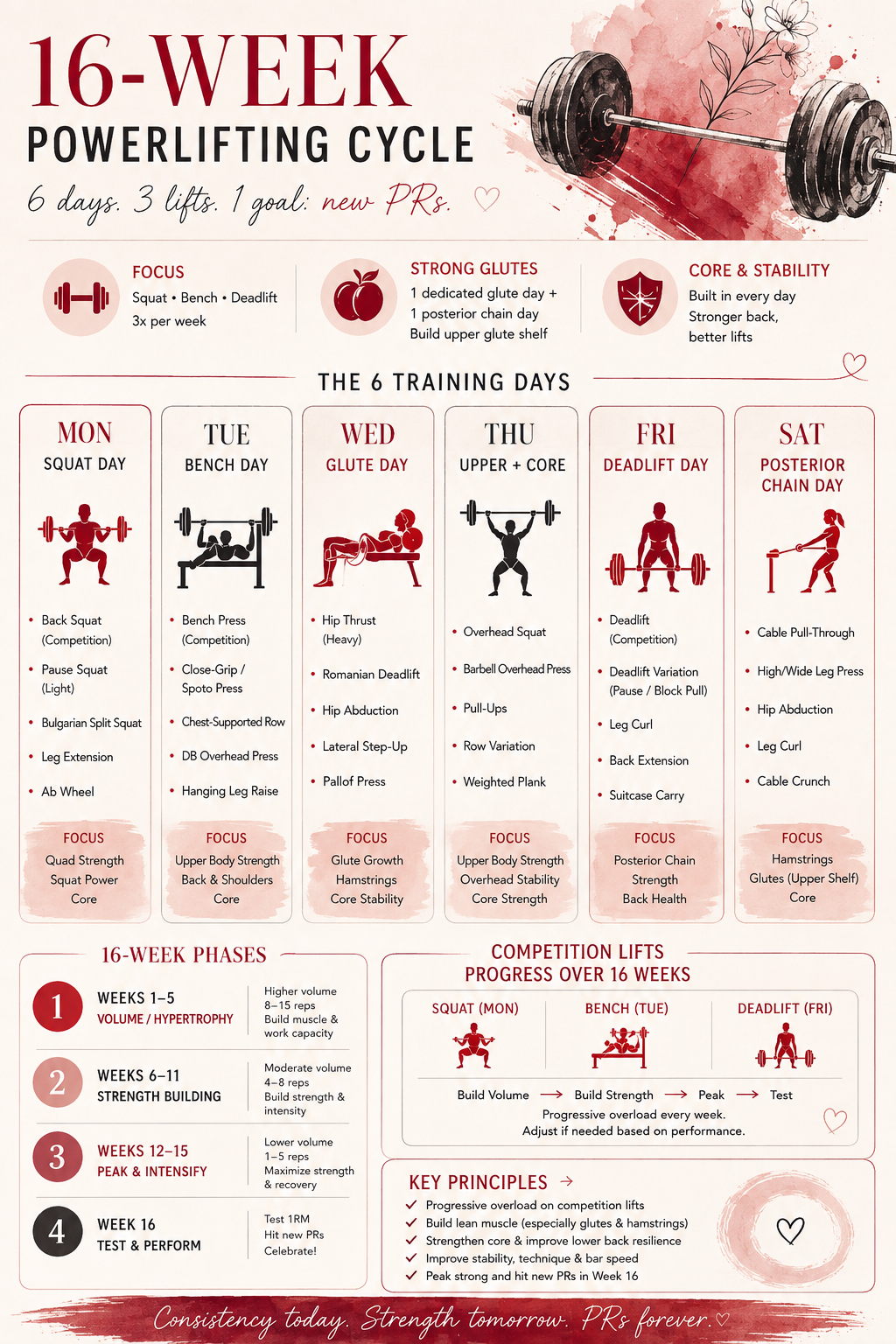
This time, I’m aiming to train six days per week. Three days revolve around the competition lifts, one is dedicated to glutes, one to upper-body and core work, and one to accessories with an emphasis on the posterior chain.
There are a few things I’ve taken into account when designing this cycle. My lower back tends to become irritated relatively quickly, so I need more core work and have to be careful with exercises that create a lot of fatigue there. Pause squats, for example, are surprisingly hard on my back even at relatively low weights, so I’m keeping them light. I also want to continue developing my hamstrings and put some dedicated work into building my upper glutes.
Here’s the split.
DAY 1 – SQUAT
- Competition back squat – according to my weekly progression table (I won’t bother you with 16 weeks of sets, reps, and kilograms)
- Light pause squat – mostly triples, starting around 50 kg and progressing cautiously
- Bulgarian split squat – 3×10 → 3×8, progressively heavier
- Leg extension – 3×12–15 → 3×10–12
- Ab-wheel rollouts – 3×15–20
The squat itself progresses from 5×5 work in the first weeks toward heavy triples, doubles, and singles. I’m already comfortable doing multiple reps at 100 kg, so the volume phase starts relatively heavy rather than spending weeks working my way back up from weights that no longer challenge me.
DAY 2 – BENCH
- Competition bench press – weekly progression
- Close-grip bench press, later changing to Spoto press
- Chest-supported row – 3×10–12 → heavier sets of 8
- Dumbbell overhead press – 3×10 → 3×8
- Hanging leg raises – 3×12–15
Bench is the lift I’m building more cautiously. Over the summer, I’ve mostly been doing three sets of five at 50 kg followed by two sets of five at 55 kg, so the new cycle starts with a straight 5×5 at 55 kg and increases slowly from there.
DAY 3 – GLUTES
- Barbell hip thrust – 4×10, progressing toward heavier sets of 6
- Romanian deadlift – starting above my current regular 80 kg working weight and progressing from there
- Hip abduction – 4×15–20 → heavier sets of 12–15
- Lateral step-ups – 3×10 → 3×8 per leg
- Pallof press – 3×10–12 per side
This is the dedicated glute day. Besides simply getting stronger, I want to continue building my upper glutes, so abduction and lateral work have a deliberate place in the program rather than being exercises I throw in whenever I have five minutes left.
The RDLs provide one of several weekly hamstring stimuli, but I’ll reduce and eventually remove them as the competition deadlift gets very heavy later in the cycle.
DAY 4 – UPPER BODY + CORE
- Overhead squat – 3×5
- Barbell overhead press – 4×8 → heavier sets of 5–6
- Pull-ups – 4 sets
- Cable or seated row – 3×10 → 3×8
- Weighted plank – 3 sets
I originally planned to have a dedicated Olympic lifting day, but eventually decided that it didn’t make much sense for this particular cycle. If the goal is to improve my powerlifting total, I’d rather use the sixth training day for supportive work.
I did keep the overhead squat, though. I enjoy it, and it challenges overhead stability, mobility, and whole-body bracing without needing to turn the session into an Olympic lifting workout.
DAY 5 – DEADLIFT
- Competition deadlift – weekly progression
- Paused deadlift, later changing to block pulls
- Seated hamstring curl – 3×10–12 → heavier sets of 8
- 45-degree back extension – 3×10–12, reducing later in the cycle
- Suitcase carries – 3 rounds per side
Deadlift is where I’m allowing the progression to move fastest. My official max is still 132.5 kg, but after pulling 120 kg for eight reps recently, that number is clearly outdated.
The cycle starts with 5×5 at 105 kg and builds fairly quickly. By the later weeks, I’ll be doing doubles and singles above my previous max before testing again in Week 16.
DAY 6 – POSTERIOR-CHAIN ACCESSORIES
- Cable pull-throughs – 4×10–12 → heavier sets of 8
- High/wide leg press – 4×10 → 4×8
- Hip abduction – 4×15–20 → heavier sets of 12–15
- Lying hamstring curl – 3×12 → 4×8–10
- Cable crunches – 3×10–15
This is not a second glute day, even though the glutes certainly get plenty of work. It’s a hard accessory session focused on the posterior chain: hamstrings, glutes, and particularly the upper glutes, together with another dose of core work.
One of the biggest changes in this program is actually the amount of core training. Instead of doing a few ab exercises here and there, I’m training the trunk in some form almost every day: ab-wheel rollouts, hanging leg raises, Pallof presses, weighted planks, suitcase carries, and cable crunches. The idea is not simply to “train abs,” but to improve bracing, anti-extension, anti-rotation, and lateral stability so that my lower back is better supported when the weights get heavy.
The 16 weeks are divided into four phases. Weeks 1–5 emphasize volume and hypertrophy. Weeks 6–11 move into heavier strength work. During Weeks 12–15, accessory volume progressively drops while the competition lifts become increasingly heavy and specific. Week 16 is testing week.
That last reduction is important. I tend to enjoy accessory work and train it hard, but there is little point in arriving at max-testing week with wonderfully trained hamstrings that are also completely exhausted.
So, for the next four months: squat, bench, deadlift; plenty of glutes and hamstrings; more core work than I have done before; and a gradual shift from building strength to expressing it.
Then, in Week 16, we find out what the numbers actually are.