What I Would Track During a PhD—and What I Would Stop Tracking
During a PhD, it is tempting to track everything. Hours worked, papers read, words written, tasks completed, emails answered, steps taken, sleep, exercise, and perhaps even the number of minutes spent away from your desk can all become data points. Some of these records can help you understand your work and make better decisions. Others simply create another layer of administration and pressure.
Looking back, I would track the information that helps me remember, evaluate, and plan. I would stop tracking numbers that encourage me to perform productivity rather than make meaningful progress. A PhD already involves enough uncertainty. Your tracking system should help you navigate that uncertainty, not make you feel as though every day must be converted into an impressive spreadsheet.
The purpose of tracking is not to prove that you worked hard. It is to leave useful clues for your future self.
What I would track
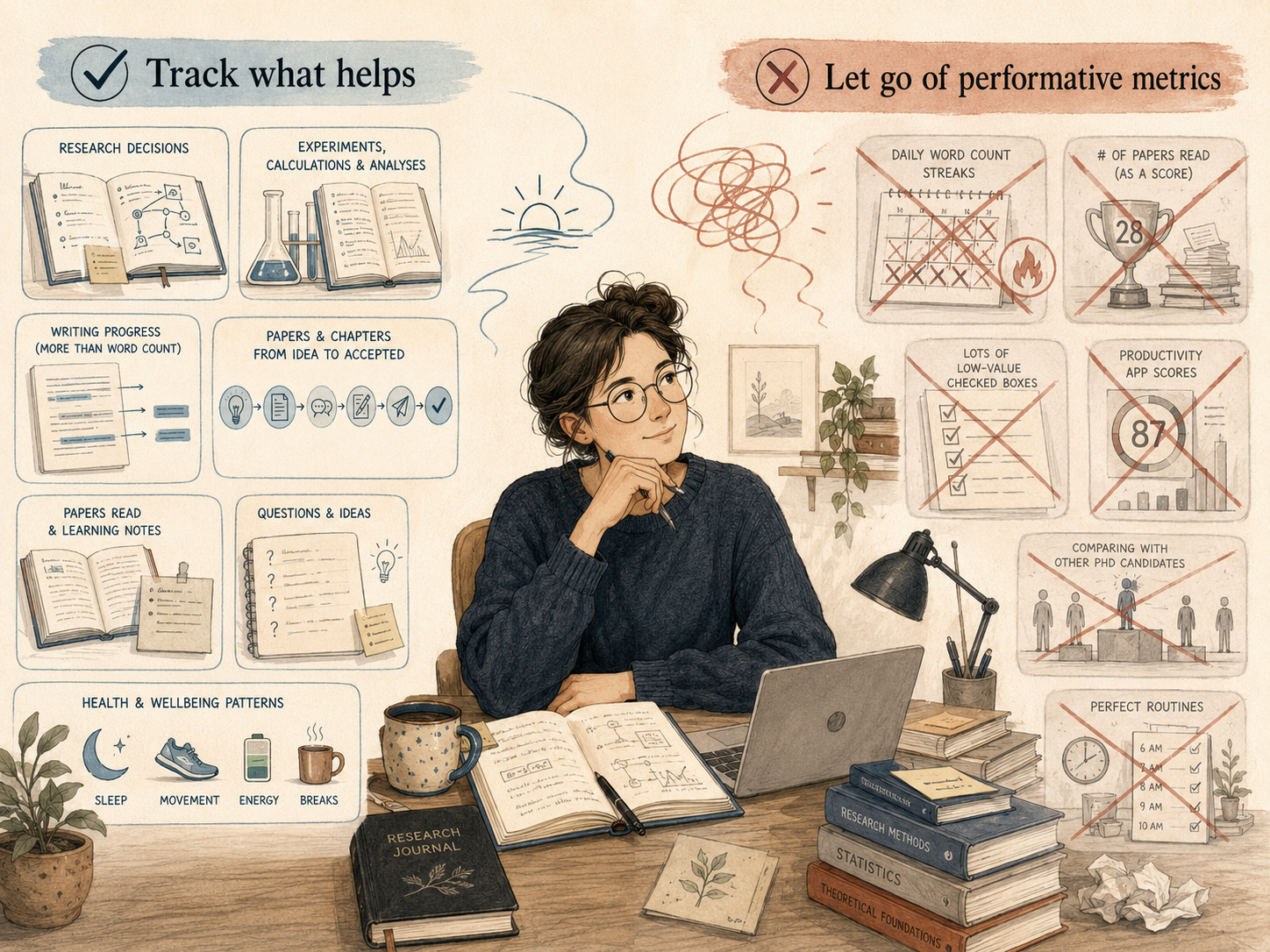
- Research decisions. I would keep a record of important decisions, including what I decided, why I made that choice, what alternatives I considered, and whether the decision should be reviewed later. Months into a project, it is easy to forget why you selected a certain method, excluded a dataset, changed a parameter, or abandoned an idea. A short decision log can save hours of confusion.
- Experiments, calculations, and analyses. For experimental work, I would maintain a detailed lab book, and scan as much of my handnotes as possible. For computational or theoretical work, I would keep an equivalent research journal with assumptions, settings, file locations, software versions, errors, and observations. Good documentation makes work reproducible and helps you distinguish between a failed idea and an idea that was never properly tested. I also always use version management on my tools. Starting a research journal and documenting your activities early are central habits for managing the PhD trajectory.
- Writing progress. I might track words written, but I would not treat word count as the only measure of progress. I would also record which section I worked on and what changed. “Revised the argument in Section 2.3” tells me more than “wrote 450 words.” Academic writing includes outlining, restructuring, deleting, checking sources, revising figures, and clarifying ideas.
- The progress of papers and chapters. I would maintain a simple overview of each paper or dissertation chapter. Useful stages might include: idea, outline, rough draft, complete draft, feedback received, revision, submitted, and accepted. This overview can show where projects are getting stuck and what the next action should be, and is very useful for supervisor and project team meetings,
- Papers read and, more importantly, what I learned from them. A list of titles is less useful than a few lines about the paper’s question, method, findings, limitations, and relevance to my own research. I would also note whether I need to return to it. The goal is not to collect references but to build understanding.
- Questions, ideas, and unresolved problems. I would keep a running list of questions that arise during reading, meetings, writing, and analysis. Some will become research directions. Others will reveal gaps in my reasoning or useful questions for my supervisor.
- Selected health and wellbeing patterns. I might track sleep, movement, macros, breaks, pain, energy, or concentration for a limited period when I am trying to understand a pattern. Some of my earlier blog postst connected difficulties with concentration to task type, lack of variation, insufficient breaks, and physical wellbeing. The important point is to use these observations with curiosity, not judgment.
What I would stop tracking
- Daily word-count streaks. Some days are for drafting; others are for thinking, reading, revising, coding, teaching, or recovering from an intense period. A broken streak does not mean that your PhD has stalled.
- The number of papers read as a competitive score. Reading twenty papers quickly is not automatically better than studying three central papers carefully. Counting papers can reward accumulation without comprehension.
- Tasks completed without considering their importance. A long list of checked boxes may hide the fact that you avoided the difficult task that would actually move the research forward.
- Productivity-app scores. Labels such as “productive,” “distracting,” and “focused” rarely understand the complexity of academic work. Reading, thinking, walking, discussing an idea, and staring at a difficult paragraph may all be necessary parts of research.
- Comparisons with other PhD candidates. Their publication count, working hours, conference schedule, and chapter progress do not provide a fair measurement of your own trajectory. Projects, disciplines, supervision, funding, personal circumstances, and institutional expectations differ too much.
- Perfect routines. I would not score myself on whether every morning, week, or semester followed an ideal schedule. A planning system should adapt to research, teaching, illness, care responsibilities, equipment failures, rejected papers, and unexpected opportunities.
A useful tracking system should reduce mental load. It should show you where you are, remind you what happened, and help you decide what to do next. When tracking becomes a second job—or a source of daily guilt—it has stopped serving its purpose.
I would therefore review every metric by asking one question: does this information change how I plan, conduct, or understand my work? When the answer is no, I would stop collecting it. The aim of a PhD is not to produce perfect productivity data. It is to develop knowledge, judgment, and the ability to carry out meaningful research.
What do you track during your PhD, and which number or productivity metric would you be relieved to stop tracking?