
How to Build a Weekly Template That Actually Works
Part of the planning and preparation for each semester is sitting down and asking myself: how can I make this semester work? Not in an ideal-world, perfectly-color-coded, never-interrupted way, but in a way that reflects the reality of academic life. Because a weekly template is not a rigid schedule that you should follow at all costs. It is a map. It helps you see where your time goes, where your priorities live, and where you need to protect space for the work that matters most.
I have written before about how I swear by my weekly template, because this habit gives you a better estimate of how much work you can realistically do in a week. This idea is at the heart of a weekly template: you are not trying to squeeze more and more into your calendar, but to understand your real capacity.
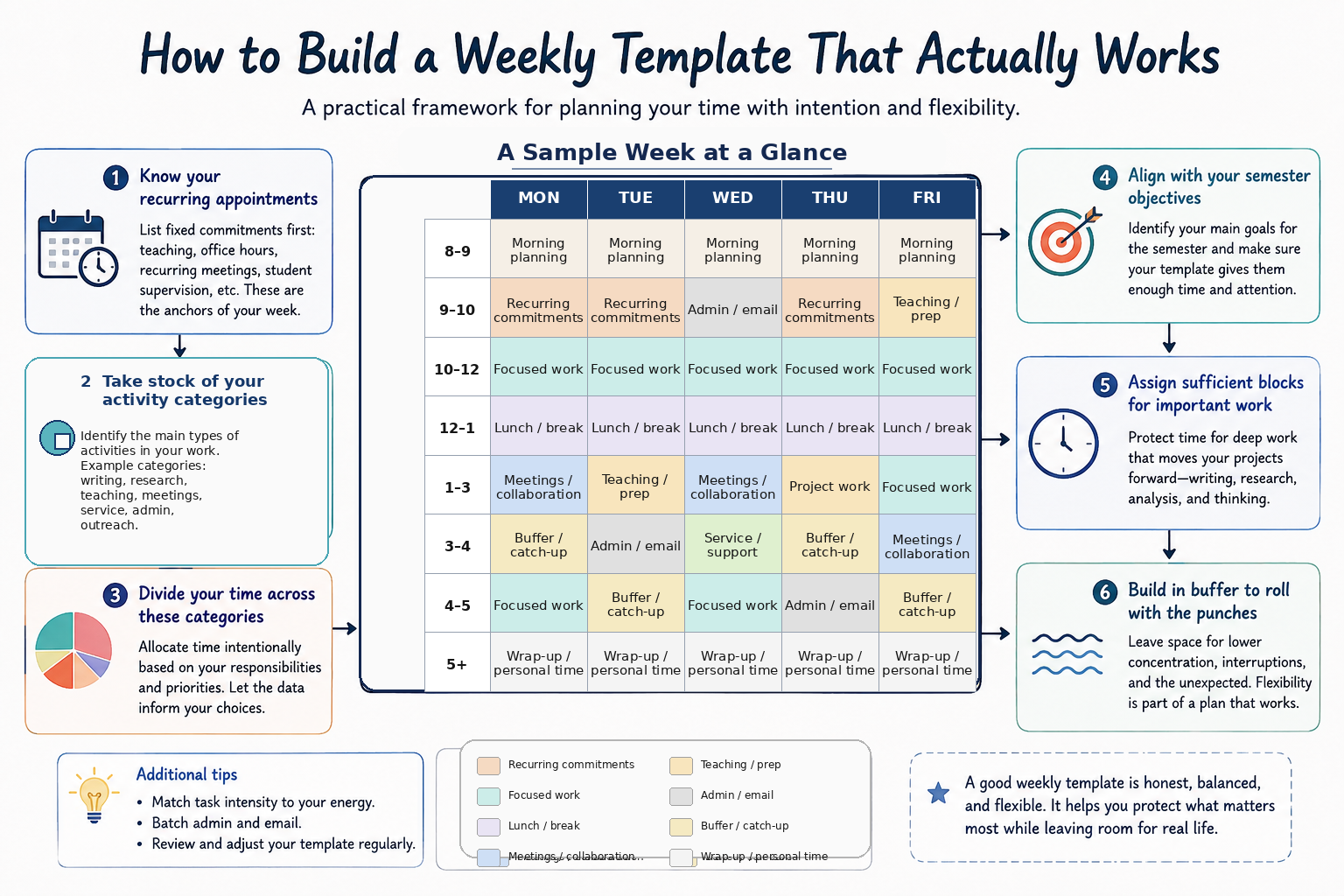
Here is how I build a weekly template that actually works:
- Start with your recurring appointments. Before you dream about deep work blocks and writing mornings, put in the fixed commitments first: teaching, office hours, recurring meetings, committee meetings, student supervision, lab responsibilities, and any other appointments that happen every week. These are the anchors of your week. Pretending they are “small” or that they do not take energy is one of the fastest ways to overplan.
- Take stock of the different types of activities in your work. For me, these categories are writing, research, decanato, teaching, service, admin, and blog. Your categories may be different, but the principle is the same: name the buckets that make up your academic life. Once you see them clearly, you can ask: how much time do I actually want or need to spend on each of these categories in a normal week?
- Divide your time across these categories. This step can be confronting. You may discover that admin and meetings already take up a large part of the week, or that writing only happens if it is squeezed into leftover time. Instead of judging the result, use it as information. A template should reflect your responsibilities, but it should also help you make intentional choices.
- Look at your semester objectives. What are the main goals for the semester? A paper submission? A grant proposal? Developing a course? Running experiments? Preparing a report? Once you know the larger objectives, check whether your weekly template gives these goals enough oxygen. If writing a paper is a major goal, but your template has only one tired hour for writing on Friday afternoon, the plan is not aligned with the objective.
- Assign sufficient blocks for your most important work. The work that moves larger projects forward often needs protected time. For me, writing, research and strategic thinking need blocks that are long enough to get into the material. Admin can often be batched into shorter blocks, but thinking, analyzing, and writing do not always fit well into scattered leftovers.
- Build in buffer. A good weekly template should not assume that every hour will be equally productive. Some days concentration is lower. Some meetings run over. Students need help. An urgent email arrives. A child gets sick. A manuscript comes back with comments. Academia requires us to roll with the punches, and your template should have room for that reality. Planning your days and weeks, self-care, and “rolling with the punches of academia” are all part of developing a workable structure for academic life.
- Match task intensity to your energy. I know that I do not do my best deep thinking in every single slot of the week. Lower-energy moments can be used for email, small admin tasks, uploading documents, or preparing teaching materials. High-energy moments deserve protection.
- Review and adjust. Your weekly template is not finished after the first version. Try it for two or three weeks. Then ask: where did I consistently overestimate myself? Which blocks were always interrupted? Which categories did I forget? Which goals still do not have enough space?
The point of a weekly template is not to become a robot. The point is to reduce the number of decisions you need to make every morning. When the shape of the week is already there, you can start the day with more clarity.
A weekly template that works is honest. It includes the meetings, the teaching, the service, the admin, and the unexpected. But it also protects the work that is most important for your semester. It gives you structure without pretending that academia is predictable. And perhaps most importantly, it reminds you that your time is finite, so your planning needs to reflect your real priorities.
How do you plan your weeks?