
Think day on Skill Development
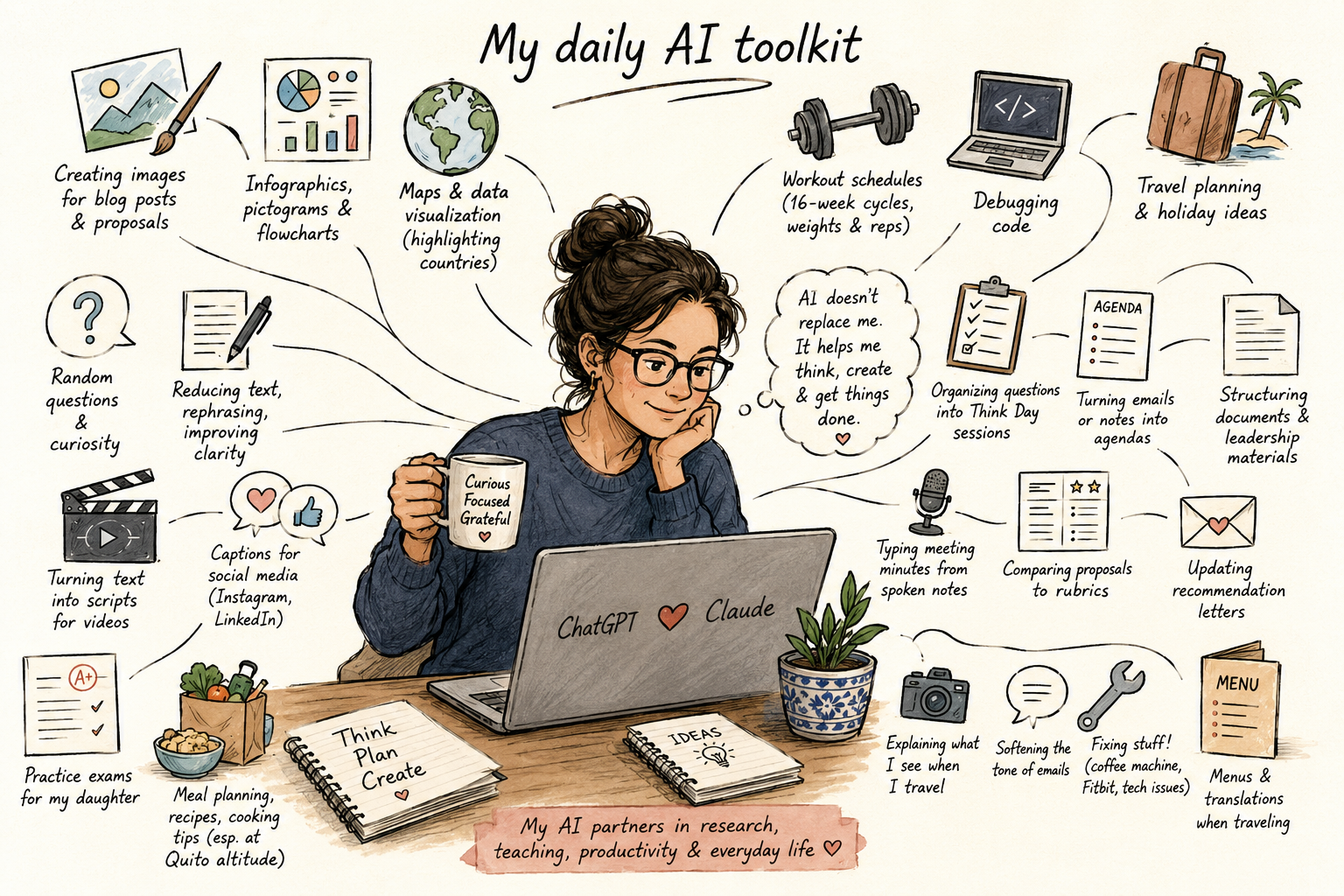
As I am working on the skills I need in my new role, I designed with ChatGPT a think day on skill development.
Here’s the template for anyone who wants to go through this exercise:
Think Day 7 — Skill Development
A 1.5-hour structured thinking session
Purpose
This session is designed to help you identify, prioritise, and plan the development of skills needed to grow into a senior academic leadership role (e.g. Dean of Research, Research Director) and/or to progress toward full professorship.
The structure moves from diagnosis → prioritisation → planning, ensuring that skill development is intentional, aligned with institutional expectations, and translated into action.
0:00–0:10 — Setting the Frame
Objective: Clarify expectations and establish a baseline.
Reflect on the following:
- What are the formal and informal expectations of your current or aspired role?
- What are the promotion or advancement criteria relevant to your position (e.g. full professor, leadership role)?
- Where do you currently feel confident?
- Where do you sense friction, uncertainty, or underdevelopment?
Exercise
Create two columns:
- What my institution(s) expect
- Where I currently stand
Write freely and intuitively. Precision comes later.
Output: A first diagnostic snapshot of role–skill alignment.
0:10–0:30 — Skill Inventory (360° Self-Audit)
Objective: Identify the full range of skills required at senior level.
Reflect on your skills across the following four domains. Use bullet points; do not self-censor.
1. Strategic Skills
Examples:
- Research strategy and portfolio design
- Long-term vision setting
- Navigating national and international funding ecosystems
- Translating institutional goals into research priorities
- Policy design and governance awareness
2. Operational / Managerial Skills
Examples:
- Leading research units, centres, or teams
- Financial literacy (budgets, resource allocation)
- Designing KPIs and performance metrics
- Delegation and decision-making
- Conflict management and negotiation
3. Academic Excellence Skills
Examples:
- Distinctive research profile and intellectual leadership
- Grant leadership at national or international scale
- Supervising and developing PhD/postdoc pipelines
- Research innovation and methodological depth
- Mentorship and talent development
4. Communication & Representation
Examples:
- Articulating research impact to non-academic audiences
- Institutional representation (ministries, industry, partners)
- Internal communication and alignment
- Public-facing academic narrative
- Cross-cultural or multilingual engagement (if relevant)
Output: A comprehensive personal skill map.
0:30–0:50 — Gap Identification (Reality Check)
Objective: Move from listing to prioritising.
For each skill identified, assess:
- Proficiency: Low / Medium / High
- Urgency: Not urgent / Important / Critical
Focus areas
- Low + Critical → immediate development priorities
- High + Critical → protect, leverage, and make visible
- Medium + Important → plan gradual strengthening
Avoid perfectionism; aim for honesty.
Output: A prioritised list of skill gaps and leverage points.
0:50–1:10 — Cross-Role and Cross-Institutional Alignment
Objective: Identify where skill development has maximum leverage.
If you operate across multiple roles or institutions, reflect on:
- Skills essential for Role A (e.g. leadership position)
- Skills essential for Role B (e.g. professorship or research excellence)
- Skills that serve both simultaneously
Reflection prompts
- Which skills create overlap and efficiency?
- Which skills reduce duplicated effort?
- Which skills are context-specific, and why?
Output: A synergy map highlighting high-leverage skills.
Synergy Map (Focus Area)
Select 3–5 skills that, if developed well, would:
- Strengthen leadership capacity
- Reinforce academic credibility
- Increase institutional influence
- Support long-term career sustainability
These become your core development focus.
1:10–1:25 — Development Roadmap
Objective: Translate insight into action.
For each priority skill, define:
- Development method
(course, mentoring, shadowing, practice, delegation, reading, applied project) - Timeline
(quarterly or 6–12 month horizon) - Success indicators
(what concrete change will show improvement?)
Keep plans realistic and integrated into existing work.
Output: A short, actionable skill development plan.
1:25–1:30 — Closing & Anchoring
Objective: Prevent insight from dissolving.
Answer in writing:
- What becomes non-negotiable in my professional development?
- Which skill or behaviour will I stop neglecting from now on?
This anchors reflection into commitment.