
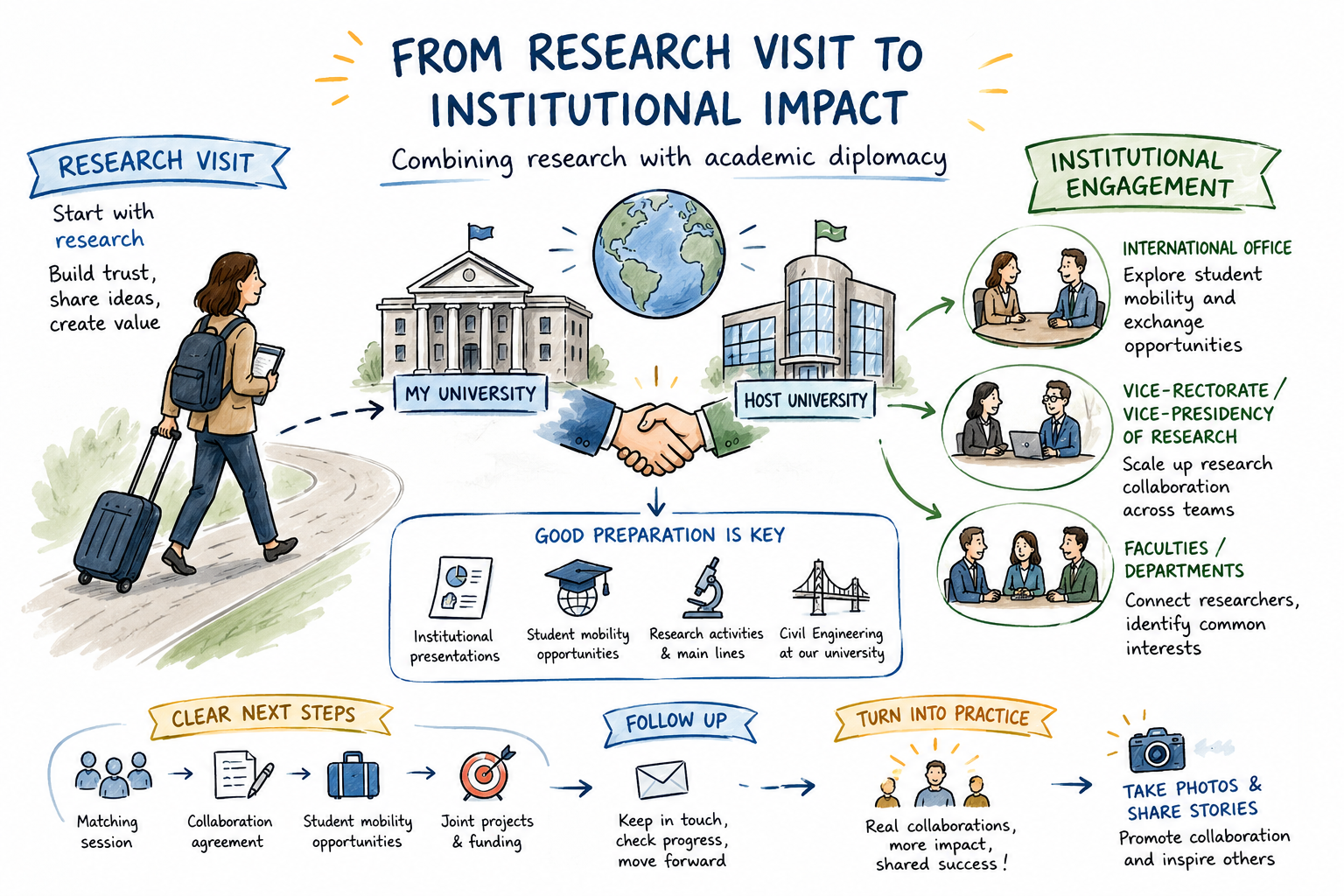
Combining research visits with academic diplomacy
One of my favorite parts of academic life is touristing around other university campuses (and visiting bridges in other countries). A research visit offers the opportunity to spend time with colleagues, discuss ideas in depth, work together on papers and proposals, and often see a new experimental technique or analytical approach. In the past, these visits were for me typically centered around a specific research project or collaboration, with the focus on meeting with my collaborators and seeing their lab.
This year, however, my role has evolved. While I still value the research component of these visits immensely, I have increasingly started to view them through a broader lens. Rather than focusing solely on the collaboration between individual researchers, I now try to combine my research visits with what I would call institutional diplomacy: creating connections that can benefit not only my own research group, but also colleagues, students, and the institutions involved.
The basic idea is simple. If I am already investing the time and resources to travel to another university, why not explore opportunities that extend beyond my own project? In addition to meetings with researchers in my field, I now try to arrange meetings with representatives from the international office, the vice-rectorate or vice-presidency of research, and other institutional stakeholders. These conversations can help identify opportunities for broader collaboration and ensure that promising research connections do not remain limited to a handful of academics. It may be a bit scary to reach out, but I often rely on my university’s international office and their contact, as well as my collaborators in their university.
One of the key advantages of involving institutional representatives is that they can help scale successful collaborations. A productive discussion between two researchers may eventually lead to a joint publication. A productive discussion supported at the institutional level can create opportunities for entire groups of researchers, facilitate student exchanges, and stimulate larger collaborative initiatives. In some cases, these conversations can lay the groundwork for formal collaboration agreements between universities.
Of course, this approach requires considerably more preparation than a traditional research visit. Before traveling, I make sure that I know my own institution thoroughly. This means having up-to-date presentations available on our university, our research activities, student mobility opportunities, and the main research strengths of our institution. Since I work in civil engineering, I also compile materials specifically focused on our civil engineering research lines, as these are usually most relevant to the researchers I meet. The better prepared I am, the easier it becomes to identify areas of mutual interest and explain how potential collaborations could fit within the broader institutional context.
Another important lesson I have learned is that every meeting should end with clearly defined next steps. It is easy to have enthusiastic conversations during a visit and then lose momentum once everyone returns to their daily responsibilities. Depending on the situation, the next step may be organizing a virtual matching session between researchers, exploring a collaboration agreement, developing student mobility opportunities, or identifying joint funding possibilities.
The work also does not end when the visit is over. Follow-up is perhaps the most important part of academic diplomacy. After returning home, I send summaries, connect colleagues who should meet each other, and keep checking in on progress by putting check-in moments on my calendar. Turning a promising conversation into an active collaboration often takes months of consistent effort. Persistence is what transforms good intentions into tangible outcomes.
Finally, do not underestimate the importance of communication. Take pictures during meetings, share highlights on institutional channels and social media, and celebrate milestones publicly. Visible examples of collaboration help strengthen relationships and encourage others to become involved. They also demonstrate that international partnerships are not simply agreements on paper, but active and growing collaborations.
Research visits will always be valuable for advancing our scholarly work. Yet by combining research activities with institutional engagement, we can create opportunities that reach far beyond our own projects. When approached strategically, a research visit can become the starting point for broader partnerships that benefit researchers, students, and institutions alike.
Have you used your mobilities to create opportunities for others at your university?